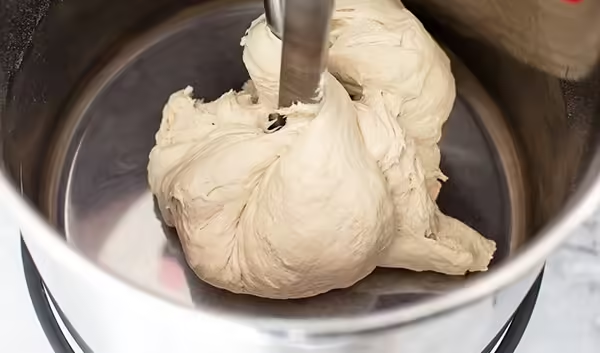

In large-scale pizza manufacturing, consistency, efficiency, and scalability are critical to success. As production volumes increase and product standards tighten, manual or semi-manual processes quickly become bottlenecks. Among all processing steps, dough preparation has the most significant impact on final pizza quality. This is where pizza dough mixers play a central role.
Industrial pizza dough mixers are no longer just mixing machines. They are engineered systems designed to deliver uniform dough quality, support automation, and integrate seamlessly into modern pizza production lines. Understanding their role is essential for manufacturers looking to scale operations while maintaining product consistency.

Pizza dough mixers are specialized machines designed to combine flour, water, yeast, oil, and other ingredients into uniform dough suitable for pizza production. In industrial environments, these mixers are built to handle high capacities, repeated cycles, and demanding operating conditions.
Unlike small commercial mixers used in pizzerias, industrial pizza dough mixers focus on precision and repeatability. Mixing speed, torque, time, and temperature control are engineered to meet strict production requirements. This ensures that every batch of dough meets the same structural and functional standards, regardless of volume.
In large-scale manufacturing, pizza dough mixers serve as the foundation of the entire process. Any inconsistency at this stage will be amplified downstream, affecting dividing, rounding, fermentation, baking, and final product quality.
One of the biggest challenges in large-scale pizza manufacturing is maintaining consistent dough quality across thousands of units per hour. Pizza dough mixers address this challenge by delivering controlled and repeatable mixing conditions.
By reducing reliance on manual labor, mixers minimize human error and variability. Automated mixing programs ensure consistent hydration, gluten development, and dough temperature from batch to batch. This stability is essential for factories producing fresh pizza, frozen pizza, or par-baked products at scale.
In addition, industrial pizza dough mixer support continuous production strategies. High-capacity designs allow manufacturers to scale output without compromising efficiency, making them a key asset for growing pizza brands and centralized food production facilities.
Different production requirements call for different mixer designs. The most common types of pizza dough mixer used in industrial facilities include spiral mixers, horizontal mixers, and continuous mixers.
Spiral pizza dough mixers are widely used for their gentle mixing action and excellent dough structure development. They are suitable for a wide range of pizza dough formulations, including high-hydration doughs.
Horizontal pizza dough mixer are designed for higher capacities and faster mixing cycles. They are often used in factories where throughput is a priority and where integration with automated feeding systems is required.
Continuous pizza dough mixer are typically used in fully automated production lines. Instead of batch processing, they allow ingredients to be fed continuously, producing a steady flow of dough. This type of mixer is ideal for very high-volume pizza manufacturing where efficiency and automation are critical.
Dough quality is determined by how well ingredients are mixed and how gluten is developed during the mixing process. Industrial pizza dough mixer are engineered to optimize both.
Precise control over mixing speed and time ensures proper gluten formation without overworking the dough. Overmixing can lead to excessive oxidation and weakened structure, while under-mixing results in poor elasticity and inconsistent texture. Industrial mixers are designed to avoid both extremes.
Modern pizza dough mixers also help control dough temperature during mixing, which is essential for fermentation performance and downstream processing. Stable dough structure leads to better machinability, more consistent proofing, and improved baking results.
As pizza manufacturing moves toward Industry 4.0 standards, automation has become a key feature of modern pizza dough mixer. Automatic mixers equipped with PLC control systems allow manufacturers to store and manage multiple recipes with high precision.
Smart pizza dough mixer can monitor parameters such as mixing time, speed, torque, and temperature in real time. This data-driven approach improves process transparency and helps manufacturers optimize production efficiency.
Automation also reduces operator dependency, improves workplace safety, and supports consistent quality across different production shifts. For large-scale operations, these advantages translate directly into lower operating costs and higher output stability.
In industrial pizza manufacturing, pizza dough mixers are rarely standalone machines. They are the first and most critical component of a complete pizza dough production line.
After mixing, dough is transferred to downstream equipment such as dividers, rounders, intermediate proofers, and forming systems. Seamless integration between the mixer and these machines is essential to avoid bottlenecks and maintain continuous flow.
Well-designed pizza dough mixer are engineered with integration in mind, supporting automated ingredient feeding, discharge systems, and synchronization with the rest of the production line. This approach enables manufacturers to implement turnkey pizza dough processing solutions rather than managing individual machines separately.
Selecting the right pizza dough mixer requires a clear understanding of production goals. Capacity is a primary consideration, but it should be evaluated alongside dough type, hydration level, production rhythm, and available floor space.
Manufacturers should also consider flexibility. The ability to handle multiple dough formulations, adjust mixing parameters, and support future capacity expansion is often more valuable than maximum output alone.
Customization is another important factor. Industrial pizza manufacturers often have unique process requirements, and working with a professional manufacturer who can tailor the mixer design to specific needs can significantly improve long-term performance and efficiency.
The cost of industrial pizza dough mixer varies depending on capacity, automation level, materials, and customization. While initial investment is an important consideration, long-term operating efficiency and return on investment are equally critical.
High-quality pizza dough mixers reduce waste, improve consistency, and lower labor costs. Energy-efficient designs and durable construction further reduce total cost of ownership over the machine’s service life.
For large-scale pizza manufacturers, investing in reliable and well-engineered pizza dough mixer often results in faster payback periods and stronger production stability.
Industrial pizza dough mixers address many of the common challenges faced by large-scale manufacturers. These include inconsistent dough quality, production bottlenecks, and dependence on skilled labor.
By standardizing the mixing process, mixers eliminate variability and ensure predictable results. Automated systems reduce downtime and improve production flow, while robust designs support continuous operation in demanding environments.
As labor shortages continue to affect the food processing industry globally, pizza dough mixers also help manufacturers maintain output levels with fewer operators.
The future of pizza dough mixer is closely tied to automation, intelligence, and sustainability. Manufacturers are increasingly adopting smart mixers with advanced monitoring and data analysis capabilities.
Customization and modular design are also becoming more important, allowing pizza producers to adapt equipment as product portfolios and market demands change. At the same time, energy efficiency and hygienic design are gaining priority as sustainability and food safety standards continue to evolve.
These trends indicate that pizza dough mixer will continue to play an even more strategic role in large-scale pizza manufacturing.
For large-scale pizza manufacturers, choosing the right equipment partner is just as important as choosing the right machine. A professional pizza dough mixer manufacturer brings engineering expertise, production experience, and system integration capabilities.
Beyond supplying equipment, experienced manufacturers can provide customized solutions, production line design support, and long-term service. This partnership approach helps ensure that pizza dough mixers deliver consistent performance throughout their lifecycle and support sustainable business growth.
What are pizza dough mixers used for in industrial production?
Pizza dough mixer are used to combine ingredients evenly and develop consistent dough structure in large-scale pizza manufacturing, ensuring stable quality and efficient production.
How do industrial pizza dough mixers differ from commercial mixers?
Industrial pizza dough mixer are designed for higher capacity, continuous operation, and precise process control, making them suitable for factory-level pizza production.
Can pizza dough mixers handle high-hydration pizza dough?
Yes, properly designed pizza dough mixer can efficiently process high-hydration dough while maintaining gluten strength and dough consistency.
Are pizza dough mixers suitable for automated production lines?
Modern pizza dough mixer can be fully integrated into automated pizza production lines and connected with PLC systems for precise and repeatable operation.
What factors should be considered when choosing pizza dough mixer?
Key factors include production capacity, dough type, automation level, customization options, and the manufacturer’s engineering and after-sales support.
If you’re unsure which pizza dough mixer are best suited for your production capacity, dough type, or automation goals, our engineering experts are here to help. We provide professional guidance and customized solutions for large-scale pizza manufacturing.
Contact us today for a personalized consultation and discover how the right pizza dough mixers can improve consistency, efficiency, and scalability in your production line. Don’t let equipment limitations hold back your growth—get in touch now and build a smarter pizza dough processing solution.