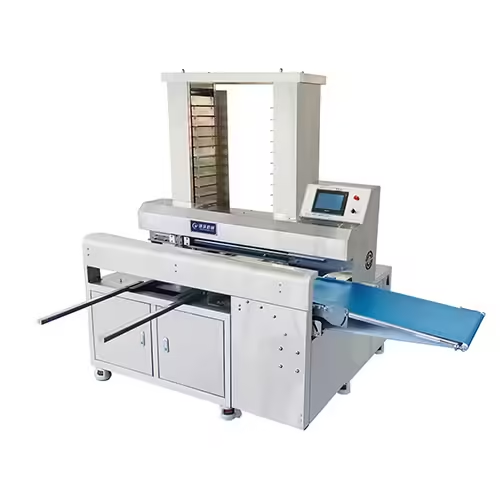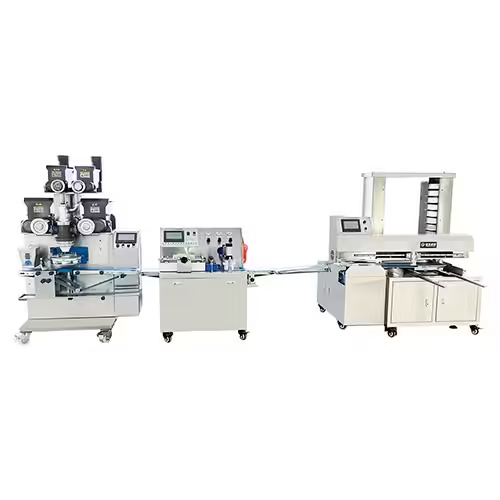

If you operate a commercial bakery or manage a bread production line, you already know that efficiency is not only about ovens and mixers. In high-volume environments, even small manual processes can become bottlenecks. One such overlooked step is pan handling. This is where a pan arranging machine becomes essential.
A pan arranging machine is designed to automatically align, position, and feed baking pans into a production line. While it may seem like a secondary piece of equipment, it directly influences production speed, labor cost, product consistency, and overall workflow stability.
In this guide, you will learn what a pan arranging machine is, how it works, how to choose the right one, and how it contributes to a scalable bakery operation. Whether you are upgrading an existing facility or designing a new automated bread line, this article will give you actionable insights based on real operational logic and industry data.
Commercial baking has evolved rapidly in the past decade. Consumer demand for consistent quality and higher output has increased, while labor costs and workforce management challenges continue to rise.
According to global food processing automation studies published by industry research institutions, automation in bakery production lines can reduce manual labor involvement by 25% to 40%, depending on the level of integration. While most bakeries invest first in mixers, dividers, and ovens, many still rely on manual tray loading. This creates inconsistencies and slows the entire process.
Manual pan arranging typically results in:
As production speed increases, manual handling simply cannot keep up. A pan arranging machine eliminates this inefficiency by synchronizing tray handling with upstream and downstream equipment.
A pan arranging machine is primarily used to automatically organize and position baking pans before they enter the dough depositing, molding, or proofing stages.
In a standard bread production line, the machine performs several core tasks:
For example, in toast bread production, pans must be positioned accurately before dough pieces are deposited. Even a few millimeters of misalignment can affect final product uniformity. Over time, these small inconsistencies reduce quality perception and increase product rejection rates.
By automating pan arrangement, you ensure each baking mold is positioned exactly where it should be, every single cycle.
Understanding how the system is built helps you evaluate quality and reliability.
The machine frame is typically constructed from food-grade stainless steel to meet hygiene standards. Structural rigidity ensures vibration resistance during high-speed operation.
The conveyor transports pans through alignment zones. High-precision belt or chain systems maintain consistent movement speed.
Mechanical guides, servo-driven pushers, or pneumatic systems position pans into correct alignment. Advanced systems use servo motors for higher precision and flexibility.
Most industrial units operate with PLC-based control systems. This allows programmable speed adjustments, synchronization with other machines, and automated diagnostics.
Photoelectric sensors detect pan presence and position. Safety interlocks prevent machine operation when guards are open.
Each of these components affects reliability, uptime, and integration capability.
Understanding the working principle helps you optimize installation and workflow.
Empty pans are delivered from a stacking system or manually placed onto the infeed conveyor.
Sensors detect pan position and confirm spacing.
Mechanical arms or guide rails adjust the pan orientation and spacing according to programmed parameters.
Pans are organized into rows or specific configurations required by the production line.
The arranged pans are transferred to the next stage, such as dough depositing or proofing.
This cycle operates continuously, ensuring smooth synchronization with high-speed bread production.
These systems still require partial human input but reduce physical workload.
These combine automated alignment with manual feeding. Suitable for medium-scale bakeries.
These integrate pan feeding, separation, alignment, and discharge. Ideal for high-capacity industrial lines.
Designed to match unique tray dimensions, multi-row configurations, or non-standard molds.
The right choice depends on your production scale and long-term expansion plans.
Selecting a pan arranging machine requires operational evaluation, not just price comparison.
Calculate trays per hour. Ensure the machine handles peak capacity, not just average output.
Different bread types require different pan layouts. Confirm compatibility with your current molds.
If you plan to scale production, invest in a fully automatic solution to avoid future replacement costs.
Measure available floor space carefully. Integration should not disrupt workflow.
A common industry benchmark suggests that automation investments in bakery lines typically achieve payback within 12 to 24 months, depending on labor cost savings and output increase.
Below is a comparative overview:
| Factor | Manual Handling | Semi Automatic | Fully Automatic Pan Arranging Machine |
|---|---|---|---|
| Labor Requirement | High | Medium | Low |
| Alignment Accuracy | Variable | Consistent | Highly Precise |
| Output Speed | Limited | Moderate | High |
| Integration Capability | Low | Medium | High |
| Long-Term Scalability | Low | Medium | High |
By eliminating manual bottlenecks, you increase throughput without adding workforce.
You minimize repetitive tasks and improve staff allocation.
Heavy trays and repetitive lifting are common injury risks in bakeries.
Uniform tray positioning ensures consistent baking results.
Automation allows you to increase line speed without redesigning infrastructure.
A pan arranging machine does not operate independently. It must integrate seamlessly with:
When properly synchronized, the entire line operates as a continuous system. Timing signals between machines prevent overloading and idle time.
Advanced systems allow digital speed adjustment to match upstream and downstream equipment automatically.
When reviewing specifications, focus on measurable performance indicators:
Do not rely solely on maximum speed claims. Evaluate sustained operational speed under full load conditions.
Often caused by improper calibration. Regular sensor alignment checks prevent errors.
Usually due to inconsistent tray dimensions. Standardization reduces this risk.
Preventive maintenance schedules significantly reduce unexpected stoppages.
Choose systems with quick adjustment mechanisms if you handle multiple product types.
A mid-scale industrial bakery producing packaged sandwich bread faced labor shortages and inconsistent tray alignment. They manually arranged 4-row toast pans before dough depositing.
After installing a fully automatic pan arranging machine:
Within 18 months, the equipment investment was recovered through labor savings and productivity gains.
Remove flour residue and debris to maintain sensor accuracy.
Check belt tension, alignment guides, and lubrication points.
Test control system calibration and safety mechanisms.
Well-trained operators prevent misuse and extend machine lifespan.
Preventive maintenance is always more cost-effective than reactive repair.
A pan arranging machine may not be the first piece of equipment you think about when building a bakery production line, but it plays a critical role in operational efficiency and consistency.
If you aim to scale production, reduce labor risk, and ensure stable workflow synchronization, automating pan handling is a logical next step. Instead of treating it as optional equipment, consider it part of a fully optimized bakery system.
When you approach automation strategically, small improvements in tray handling can unlock significant gains across your entire production line.
How many pans per minute can a pan arranging machine handle
Capacity depends on configuration, but industrial systems can typically process dozens of pans per minute.
Can it work with different tray dimensions
Yes, adjustable guide systems allow handling of multiple sizes.
Does automation really reduce labor costs
Yes. Industry automation research consistently shows labor reduction between 25% and 40% when integrating tray handling systems.
Is customization available
Most industrial systems can be tailored to match unique production layout s.
How long does a pan arranging machine last
With proper maintenance, industrial units can operate reliably for many years.
If you’re unsure which pan arranging machine best fits your bakery or production line, our experts are here to guide you. Contact us today for a personalized consultation, and ensure your bakery operates efficiently, safely, and with consistent product quality. Don’t wait to optimize your workflow—get in touch now to elevate your production and protect your investment!