
If you are looking to grow a bakery, café, or small food manufacturing business, you may have wondered how to maintain bread quality while scaling output. Investing in a mini bread production line is one of the most effective ways to achieve consistent quality, reduce labor costs, and expand your product range without sacrificing your brand standards.
Mini bread production lines bridge the gap between traditional handcrafting and full industrial automation. They are tailored for small but rapidly expanding operations that want repeatable results, fast turnaround times, and the ability to serve more customers without increasing overhead dramatically.
In this comprehensive guide, you will learn how mini bread production lines work, key components, real examples from the field, performance comparisons, operational tips, and clear guidance on selecting the right system for your business. Whether you make artisan loaves, sandwich bread, baguettes, or speciality rolls, this article gives you actionable insight that you can put to work immediately.
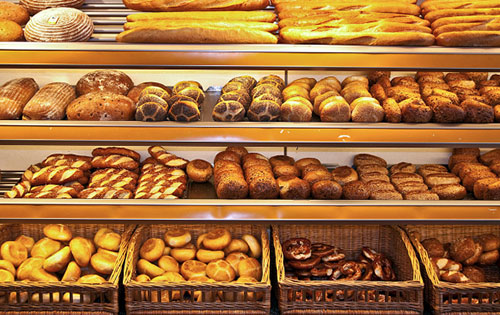
Bread is one of the most common staple foods in the world, yet it is deceptively complex to produce at scale with consistent quality. Manual processes can be unpredictable, and relying heavily on skilled labor makes scaling difficult. According to industry insights shared by the United Nations’ Food and Agriculture Organization, mechanized production increases efficiency and consistency across batches while reducing waste and dependency on manual labor.
With a mini bread production line, you can:
You can explore broader manufacturing trends in bakery automation at the Global Food Security Information Network.
Small‑scale automation is no longer just for big factories. With advances in compact design, flexible production options, and programmable controls, mini bread lines are helping family bakeries, startups, and boutique brands scale smarter.
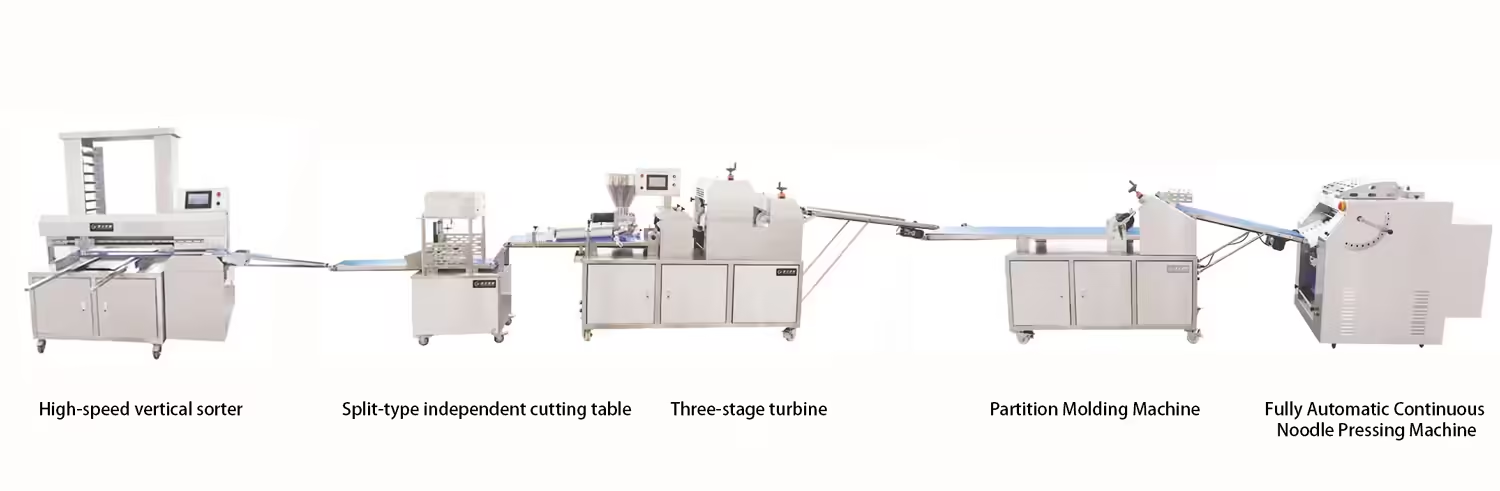
A mini bread production line is a compact, semi‑automated, or fully automated system designed to handle bread production tasks that would otherwise be done manually. It typically includes dough mixing, kneading, portioning, shaping, proofing, and sometimes even baking. The goal is not only to increase output but also to standardize quality.
This type of line is ideal when you want industrial‑level consistency but don’t yet require the massive capacity of a full industrial system.
Key stages in most mini bread lines include:
Each stage can be controlled with timing, temperature, and speed to match your recipe’s optimum process.
For insights into bakery process control, check out resources from the Institute of Food Technologists.
Below is a typical configuration you should expect when evaluating lines:
| Module | Function | Benefit |
|---|---|---|
| Mixer/Kneader | Mixes flour and liquids into dough with controlled energy | Ensures uniform gluten development |
| Divider | Cuts dough into consistent portions | Reduces weight variation |
| Rounder | Rounds dough pieces | Starts dough shaping process |
| Moulder | Shapes dough into specified loaf form | Improves bread appearance and texture |
| Proofing Cabinet | Controls humidity and temperature | Ensures consistent rise |
| Conveyor | Moves product between stages | Reduces manual handling |
This breakdown is consistent with workflow recommendations from experts at The Bread Bakers Guild of America.
This is where transformation begins. A high‑quality mini bread production line uses programmable mixing cycles to control dough development precisely, which matters because gluten structure and dough temperature directly influence final bread texture.
Consistency in weight means consistency in baking performance and customer experience. Automated dividers ensure every piece of dough is uniform, matching your price points and portion expectations.
Rounded dough has better strength and structure for final shaping. This is especially important for products like sandwich bread and rolls.
The shaped dough is sized and formed according to your product design—whether that’s a standard pan loaf, baguette, or specialty shape.
A controlled proofing environment ensures all dough pieces rise uniformly. Proofing cabinets with controlled humidity reduce the risk of drying or irregular fermentation.
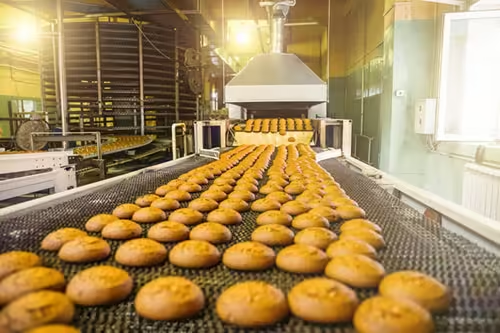
Some mini lines include small ovens capable of handling modest batch sizes, while others are integrated with existing oven infrastructure.
Industry process explanations for proof‑baking cycles can be found with organizations such as the American Society of Baking.
Consider a boutique bakery producing artisan sourdough loaves for local markets. Prior to automation, their workflow relied on manual mixing and hand shaping, with production limited to about 120 loaves per day. As demand grew, quality inconsistency and labor bottlenecks became a constraint.
After implementing a mini bread production line with a programmable mixer and automated divider/rounder modules, the bakery achieved:
This shift allowed them to offer advance orders for the first time and enter new local distribution channels. Businesses like this often report greater consumer satisfaction when bread characteristics—such as softness and volume—are consistent from batch to batch.
Selecting the ideal system depends on several factors:
Estimate your current daily output and expected growth. Mini lines are ideal up to roughly 500–1000 loaves/day depending on configuration.
Flatbreads, pan loaves, rolls, and other specialties have different processing requirements. Lines with adjustable portioning and mold options support greater product diversity.
Measure your available floor space. Mini lines are designed for compact footprints, but you still need space for proofing cabinets and associated utilities.
Some lines offer semi‑automatic operation (where an operator still manages transitions), while others are fully automated end‑to‑end.
For additional decision criteria, explore articles on effective bakery layout planning from Food Quality & Safety.
| Feature | Mini Bread Line | Full Industrial Line |
|---|---|---|
| Output Capacity | Up to ~1000 loaves/day | 2000+ loaves/day |
| Initial Investment | Lower | Higher |
| Automation Level | Medium to High | Very High |
| Flexibility | High | Moderate (specialized) |
| Footprint | Compact | Large |
| Ideal For | Small to medium bakeries | Large factories |
This table illustrates why mini lines provide a balance of efficiency and cost for growing bakeries.
When assessing cost, calculate not just the equipment price but total cost of ownership. This includes:
Most operators see ROI from a mini bread production line within 12–24 months due to labor savings and increased sales capacity.
For further ROI modeling strategies, see resources like the International Finance Corporation’s food processing guidelines.
Maintaining your mini bread production line ensures less downtime and better performance.
You can read more about preventive maintenance practices at Food Engineering Magazine.
Even well‑designed systems require thoughtful integration. Typical challenges include:
Successful deployments invest as much time in process alignment as they do in equipment selection.
Mini bread production lines are more than machines—they are strategic assets that help you scale with confidence, improve quality, and expand your business capabilities without proportionally increasing labor or complexity.
At Chengwo Food Machinery, we help small and medium bakeries find the right processing systems that align with their production goals and growth plans. If you’re ready to explore equipment options and workflow design that match your ambitions, let’s start the conversation.
What capacity does a mini bread production line typically support?
Most lines support 300–1000 loaves per day, depending on configuration.
Can the same line produce different types of bread?
Yes, lines with adjustable portioning and molding modules accommodate multiple bread styles.
How much floor space does a mini line require?
Floor space requirements vary, but many mini lines are designed for compact bakery spaces, typically occupying a few square meters.
What maintenance is required for a mini bread production line?
Routine cleaning, periodic calibration, and visual inspection of moving parts are essential.
Does automation impact bread quality?
Properly configured automation improves consistency, reduces variability, and supports repeatable results.