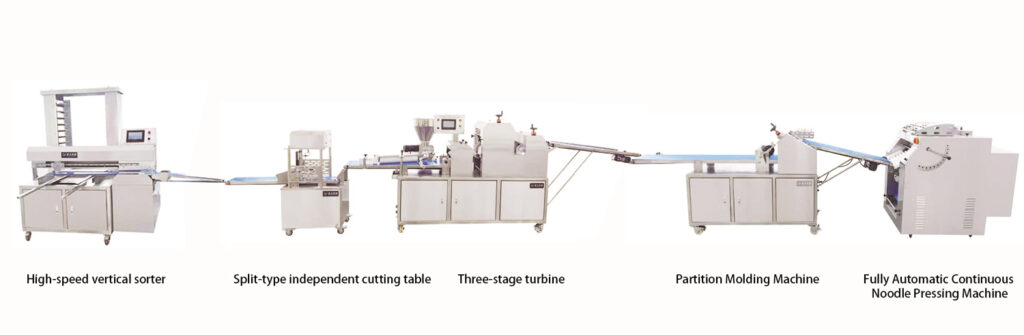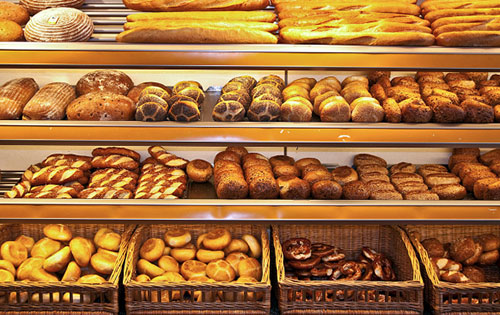

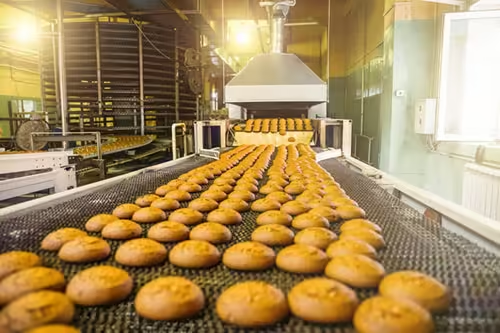
Efficient food production demands precision, speed, and reliability. Machines for food serve as a vital tool for manufacturers to achieve consistent product quality while minimizing downtime. Integrating the right equipment into your workflow—from mixing and processing to packaging and quality control—can significantly boost productivity. In this blog, we explore how modern machines for food streamline production processes, key factors to consider when selecting equipment, and the advantages of automation in the food industry.
Large-scale food production faces challenges such as maintaining consistent quality, meeting high demand, and reducing waste. Machines for food address these challenges by:
According to recent industry reports, companies that implement automated food processing equipment see productivity increases of up to 40% (source: Food Processing Insights, 2025).
Automated mixers and blenders are critical for dough, batter, sauces, and other semi-liquid products. They ensure uniform mixing, reducing inconsistencies that can affect final product quality.
These machines improve accuracy in product size and weight, enhancing packaging efficiency and reducing material waste.
Industrial ovens, steamers, and fryers designed for high-volume production maintain precise temperatures and timing for consistent results.
Automated packaging lines speed up final product preparation while preserving hygiene standards, which is essential in commercial production environments.
| Equipment Type | Main Function | Ideal Use Case | Key Benefit |
|---|---|---|---|
| Automated Mixer | Mix ingredients uniformly | Dough, batter, sauces | Consistent quality, faster prep |
| Portioning Machine | Accurate portion control | Pastries, snacks, frozen foods | Reduced waste, uniform products |
| Industrial Oven | Precise baking/cooking | Bread, cakes, large-scale baking | Even cooking, scalable |
| Packaging Machine | Product wrapping and sealing | Ready-to-sell products | Hygienic, efficient packaging |
| Conveyor Systems | Material transport between stations | Multi-step processing lines | Streamlined workflow |
Industry analysis shows that implementing advanced food processing equipment can reduce production downtime by up to 25%, enabling companies to meet high demand without quality compromise (source: Manufacturing Automation Journal, 2025).
Machines for food are more than just machinery—they’re the backbone of efficient, scalable, high-quality food production. Integrating the right machines into your workflow enhances efficiency, ensures consistency, and minimizes waste. To elevate your production to new heights, evaluate your current processes, identify bottlenecks, and invest in food processing equipment tailored to your specific needs.
The Chengwo team has decades of expertise in helping bakeries enhance efficiency and automation. If you’re ready to upgrade your production line, contact us today to discover how our intelligent food processing solutions can support your success.
Can machines for food handle multiple product types?
Yes. Many machines are versatile, allowing you to process different products with minimal adjustments.
Are these machines energy efficient?
Modern food processing equipment are designed to optimize energy use, reducing both costs and environmental impact.
How do I ensure consistent product quality?
Consistency comes from precise control systems in automated machines, reducing human error in production.
Can I integrate new machines into an existing production line?
Absolutely. Many machines are modular and can be added to existing workflows without major disruptions.