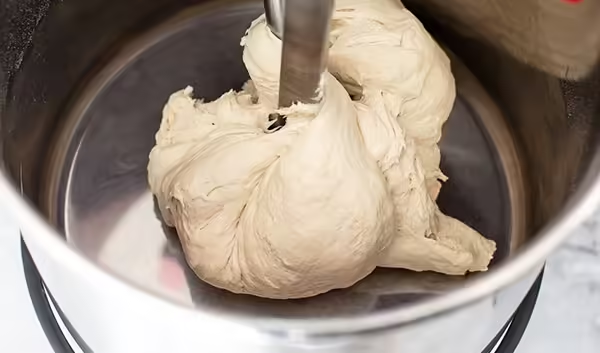

In large-scale bread production, dough quality directly determines product consistency, texture, and baking performance. As bakeries scale up to meet growing demand, traditional manual kneading methods become inefficient and difficult to control. This is where kneading bread machines play a critical role.
Industrial bread-kneading machines are designed to deliver precise, repeatable dough development while supporting high-capacity and automated production. They are a foundational component in modern bread manufacturing lines, ensuring efficiency, stability, and scalability.
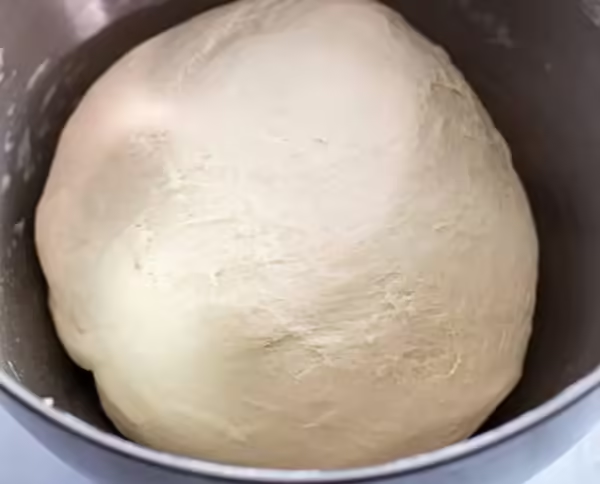
Kneading bread machines are specialized equipment used to mix and knead dough ingredients into a homogeneous and elastic mass. In industrial environments, these machines are engineered for continuous operation, high output, and consistent results.
Unlike small bakery mixers, industrial bread kneading machines focus on controlled kneading action, torque management, and temperature stability. These factors are essential for producing dough with a uniform gluten structure, which is critical for large-scale bread manufacturing.
In production facilities, bread-kneading machines serve as the starting point of the entire process. Any inconsistency at this stage can affect fermentation, shaping, baking, and final product quality.
Large-scale bread production requires strict control over dough properties. Kneading bread machines ensure consistent dough development across every batch, regardless of production volume.
By automating the kneading process, manufacturers reduce labor dependency and eliminate variations caused by manual handling. This results in predictable dough behavior during proofing and baking, which is essential for maintaining product standards.
In addition, bread-kneading machines support continuous and high-speed production environments, enabling bakeries to scale output without sacrificing quality.
Different bread products and production capacities require different types of bread kneading machines.
Spiral kneading machines are commonly used for artisan-style and high-hydration bread dough due to their gentle kneading action and excellent gluten development.
Horizontal kneading machines are designed for higher-capacity industrial applications. They offer faster kneading cycles and are often integrated with automated ingredient feeding systems.
Continuous kneading machines are used in fully automated bread production lines, where ingredients are fed continuously to maintain steady dough output. These machines are ideal for factories producing bread at very high volumes.
Dough quality depends heavily on how effectively gluten is developed during kneading. Industrial bread-kneading machines are designed to optimize this process.
Precise control of kneading speed, time, and mechanical force ensures balanced gluten development without overheating or damaging the dough. Proper kneading improves dough elasticity, gas retention, and overall bread structure.
Modern bread kneading machines also help maintain stable dough temperature, which is crucial for fermentation performance and consistent baking results.
Automation has become a standard feature in modern bread-kneading machines. PLC-controlled systems allow operators to store multiple recipes and maintain consistent kneading parameters across different production runs.
Intelligent monitoring systems track kneading time, motor load, and dough temperature in real time. This data-driven approach helps manufacturers improve efficiency, reduce waste, and maintain quality control.
Automated bread-kneading machines also enhance workplace safety and reduce reliance on skilled manual labor, which is increasingly important in large-scale food production.
In industrial bakeries, bread kneading machines are rarely used as standalone equipment. They are integrated into complete bread production lines that include dividers, rounders, proofers, and baking systems.
Proper integration ensures smooth dough transfer and continuous production flow. Well-designed bread kneading machines support automated discharge systems and synchronization with downstream equipment.
This integrated approach allows manufacturers to implement turnkey bread production solutions rather than managing separate machines independently.
Selecting the right bread-kneading machine depends on production capacity, dough formulation, and automation requirements. Manufacturers must consider not only current output needs but also future expansion plans.
Flexibility is another key factor. A well-designed bread kneading machine should accommodate different dough types and production schedules without compromising performance.
Customization options, such as bowl size, control systems, and integration interfaces, can significantly improve long-term efficiency and return on investment.
The cost of industrial bread-kneading machines varies depending on capacity, automation level, and customization. While upfront investment is important, long-term operational efficiency is often more critical.
High-quality bread-kneading machines reduce labor costs, minimize product waste, and improve overall production stability. Durable construction and energy-efficient designs further lower the total cost of ownership.
For large-scale bread manufacturers, investing in reliable bread kneading machines often leads to faster payback and sustainable growth.
Industrial bread-kneading machines help address common production challenges such as inconsistent dough quality, production bottlenecks, and labor shortages.
By standardizing the kneading process, these machines ensure predictable dough performance and stable output. Automated systems reduce downtime and improve production flow in high-demand environments.
As global bakeries face increasing pressure to scale efficiently, bread-kneading machines have become a strategic asset in modern bread manufacturing.
The future of kneading bread machines is driven by automation, intelligence, and sustainability. Smart systems with advanced monitoring and data analysis are becoming increasingly common.
Manufacturers are also focusing on hygienic design, energy efficiency, and modular construction to meet evolving food safety and environmental standards.
These trends indicate that bread-kneading machines will continue to play a vital role in the evolution of large-scale bread production.
Choosing the right equipment partner is essential for long-term success. A professional bread-kneading machine manufacturer offers engineering expertise, customization capabilities, and production line integration support.
Beyond equipment supply, experienced manufacturers provide solution-oriented services, from process design to after-sales support. This partnership approach ensures that kneading bread machines deliver reliable performance throughout their lifecycle and support sustainable business growth.
What is a kneading bread machine used for?
A bread kneading machine mixes and develops dough uniformly, ensuring consistent quality and elasticity in large-scale bread production.
How does an industrial bread-kneading machine differ from a commercial mixer?
Industrial bread kneading machines handle higher capacities, continuous operation, precise mixing control, and integration with automated production lines.
Can bread-kneading machines handle high-hydration dough?
Yes, they are designed to process a variety of dough types, including high-hydration recipes, while maintaining optimal gluten structure.
Are bread-kneading machines suitable for automated bread production lines?
Absolutely. Modern machines can integrate with PLC systems, automatic feeding, and downstream equipment for fully automated production.
What should I consider when choosing a bread kneading machine?
Key factors include production capacity, dough type, automation level, customization options, and the manufacturer’s engineering support.