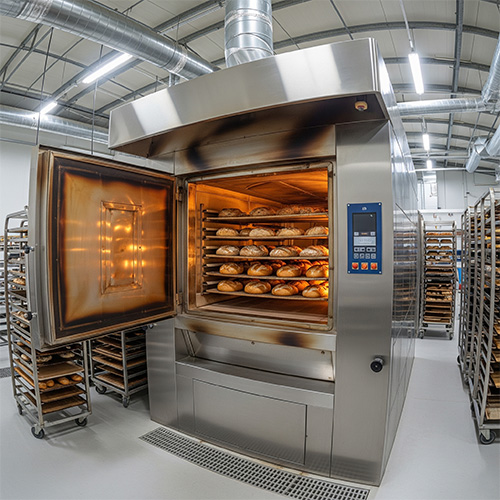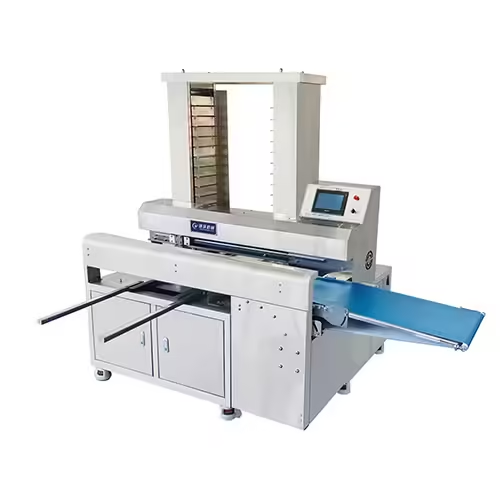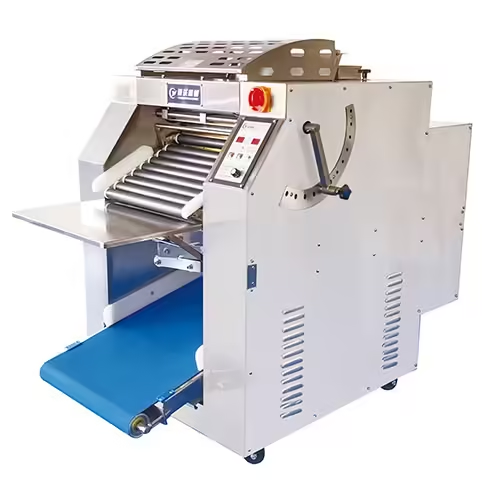

Modern food factories rely on advanced baking systems to achieve stable output, consistent quality, and efficient large-scale production. For manufacturers producing bread, biscuits, cookies, cakes, or snacks, choosing the right industrial baking solution is a strategic investment that directly affects productivity and operating costs.
This guide explains how industrial baking systems work, where they are applied, and how food manufacturers can select the right solution from a professional equipment manufacturer.
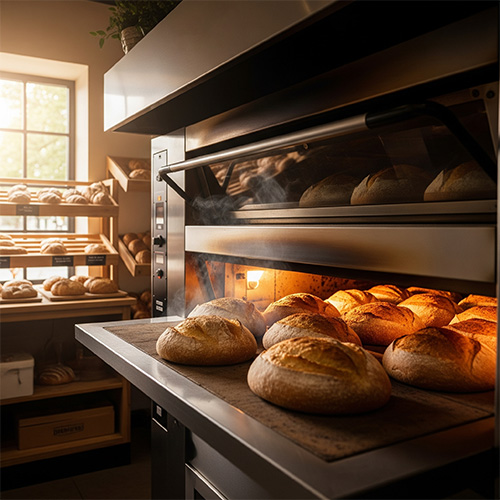
Industrial baking equipment refers to large-scale baking systems designed for continuous operation in food processing environments. Compared with standard commercial machines, these systems are built for higher capacity, longer operating hours, and more precise control.
They are widely used in food factories where uniform baking results, production stability, and automation are essential. In most cases, baking equipment is integrated into a complete production line, ensuring smooth and efficient workflows.
Different production goals require different baking solutions. Understanding the main equipment types helps manufacturers choose a suitable system.
Industrial ovens are the core component of any baking process. Common options include tunnel ovens, conveyor ovens, and batch ovens. Tunnel ovens are often selected for continuous production thanks to their consistent heat distribution and high throughput.
Many factories operate full baking lines rather than standalone machines. These integrated systems combine feeding, baking, cooling, and sometimes packaging, reducing manual handling and improving process consistency.
Industrial baking systems are designed to support a wide range of baked products across different industries.
Bread manufacturers require stable temperature control and uniform baking time to maintain texture and volume. Automated baking systems help achieve reliable results even during long production runs.
For cookies and biscuits, continuous operation and consistent heat exposure are critical. Well-designed baking lines help maintain product shape, color, and moisture levels.
Cakes and pastries require more delicate baking conditions. Customized baking solutions allow manufacturers to fine-tune parameters for different recipes and product sizes.
Advanced baking systems are designed to maximize output while minimizing operational risks.
Automated control systems allow baking lines to run continuously with minimal manual intervention. This improves production efficiency and reduces labor dependency.
Precise temperature regulation and controlled airflow ensure uniform baking results, helping manufacturers reduce product waste and improve overall quality.
Choosing the right baking system requires evaluating several technical and operational factors.
The system should match both current production needs and future expansion plans. Proper capacity planning helps avoid bottlenecks and unnecessary upgrades.
Energy consumption plays a major role in long-term operating costs. Manufacturers can select gas-fired or electric heating options depending on local energy conditions.
Modern baking lines typically use PLC-based control systems, allowing operators to monitor performance and adjust parameters easily.
| Aspect | Commercial Baking Machines | Industrial Baking Systems |
|---|---|---|
| Production Scale | Small to medium | Large-scale continuous |
| Automation | Limited | High-level automation |
| Operating Time | Intermittent | Long-term operation |
| Customization | Low | High |
| Process Stability | Moderate | Excellent |
Every food factory has unique production requirements. Standard configurations may not always deliver optimal results.
Customized baking systems allow manufacturers to adapt oven length, heating zones, conveyor speed, and control logic to specific products and factory layouts.
As a professional baking equipment manufacturer, we design and produce customized solutions based on customer requirements. From system layout to automation level, each project is engineered to support efficient and reliable production.
Choosing the right supplier is just as important as choosing the right system.
Working directly with a manufacturer provides access to engineering expertise, flexible customization, and competitive factory pricing.
A reliable partner should offer system design, installation support, operator training, and responsive after-sales service.
Long-term performance depends on professional support throughout the equipment lifecycle.
Proper installation and commissioning ensure that baking systems operate safely and efficiently from the start.
Stable spare parts supply and technical support help minimize downtime and extend system lifespan.
Global food manufacturers require systems that meet international standards and regulations.
High-quality baking systems are designed to meet CE, ISO, and other international requirements.
Manufacturers with export experience understand regional regulations and technical expectations, helping customers reduce project risks.
Before making a final decision, manufacturers should evaluate product type, output requirements, automation needs, and long-term growth plans. Working with an experienced manufacturing partner helps ensure the system is correctly designed from the beginning.
Advanced baking systems play a key role in improving efficiency, consistency, and scalability in food manufacturing. Selecting the right solution—and the right manufacturing partner—can significantly impact long-term production performance.
As an experienced industrial baking equipment manufacturer, we provide custom-designed baking solutions, reliable production systems, and professional technical support for food factories worldwide. Whether you are planning a new line or upgrading existing equipment, our team is ready to help you build an efficient and dependable baking operation.
Contact us today to receive a customized solution and competitive factory quotation.
What is industrial baking equipment used for?
Industrial baking equipment is used in food factories to bake products such as bread, biscuits, cookies, cakes, and snacks in large volumes. It is designed for continuous operation, stable quality, and efficient production.
How do I choose the right industrial baking equipment for my factory?
The right system depends on your product type, required output capacity, automation level, and available factory space. Working directly with an experienced manufacturer helps ensure the equipment is properly matched to your production needs.
What is the difference between commercial and industrial baking equipment?
Commercial equipment is typically used for small to medium-scale production, while industrial systems are built for large-scale, continuous operation with higher automation, durability, and customization options.
Can industrial baking equipment be customized?
Yes. Industrial baking systems can be customized in terms of oven size, heating method, control system, and production line layout to meet specific product and factory requirements.
What support should I expect from an industrial baking equipment manufacturer?
A professional manufacturer should provide technical consultation, system design, installation guidance, operator training, and long-term after-sales support to ensure reliable operation.
If you’re unsure which baking system is best for your production line or food factory, our experts are here to help. As an experienced industrial baking equipment manufacturer, we provide professional consultation and customized solutions tailored to your production needs. Contact us today for a personalized recommendation and competitive factory pricing, and build a reliable, efficient, and scalable baking operation. Don’t delay your production upgrade—get in touch with us now to discuss your project!