
If you are planning to expand flat bread production, manual or semi-automatic processes quickly become a bottleneck. Rising labor costs, quality inconsistency, and unstable production speed often limit growth. That is why more bakeries and food manufacturers are shifting toward automated flat bread production line solutions.
From a food machine manufacturer’s perspective, modern flat bread production line technology is not only about automation. It is about helping you produce consistent, high-quality products while improving operational efficiency, reducing waste, and creating a scalable production structure that supports long-term growth.
In this guide, you will learn how flat bread production line technology works, how you can choose the right system, and how you can apply it in real production scenarios to solve practical problems.
Consumer demand for flat bread products continues to grow globally, driven by convenience food trends, ready-to-eat meal demand, and quick-service food expansion. At the same time, production environments are facing pressure to increase efficiency while maintaining product quality and food safety.
According to publicly available food industry automation research reports, automated bakery production can reduce manual labor requirements by 30–60 percent while improving product consistency by over 40 percent when properly configured. These numbers highlight why automation is no longer a luxury investment but a necessary step for competitive food manufacturers.
When you rely on manual dough forming and baking processes, you often face issues such as:
• Uneven dough thickness
• Inconsistent baking color
• Unstable daily production output
• High staff training requirements
• Production downtime caused by human error
A well-designed flat bread production line solves these issues through synchronized dough processing, shaping, proofing, baking, and cooling systems.
A flat bread production line is a continuous automated system designed to process dough into flat bread products such as tortillas, pita bread, naan-style bread, and similar products.
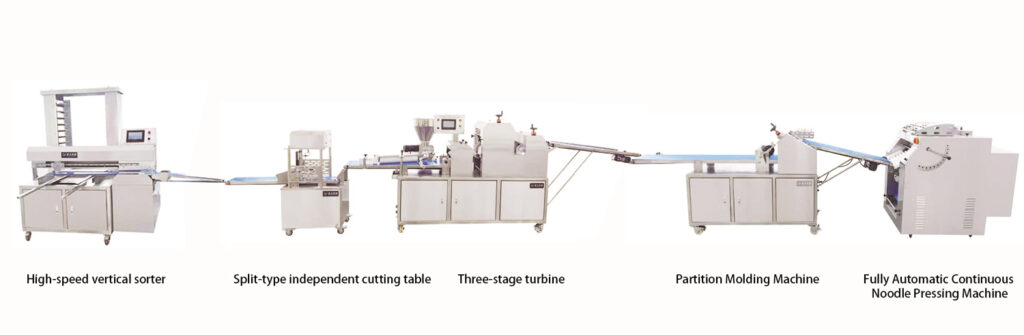
A typical production line includes:
• Dough mixing and kneading system
• Dough resting or intermediate proofing section
• Dough dividing and rounding equipment
• Dough sheeting and flattening system
• Baking oven section
• Cooling conveyor system
• Packaging integration interface
Each stage is designed to maintain dough structure, temperature control, and production rhythm. When properly configured, the entire line works as one synchronized system rather than separate machines.
When you upgrade to a full production line, you are not only increasing speed. You are building a production structure that supports quality stability and cost control.
Automated thickness control and temperature monitoring ensure every flat bread piece meets your product standard. This is especially critical when supplying chain restaurants or retail distributors.
Continuous production eliminates manual transfer delays between steps, allowing stable output during long production runs.
Although initial investment may be higher, automated production typically reduces long-term cost through labor reduction, lower material waste, and improved energy efficiency.
Closed system design reduces contamination risks and simplifies cleaning and sanitation processes.
The right production line depends on your production volume, product type, and facility space. The table below helps you quickly compare typical system configurations.
| Configuration Type | Output Range (Pieces/Hour) | Automation Level | Suitable For | Investment Level | Flexibility |
|---|---|---|---|---|---|
| Semi-Automatic Line | 800 – 2,000 | Medium | Small bakeries scaling production | Lower | High |
| Standard Automatic Line | 2,000 – 6,000 | High | Growing food manufacturers | Medium | Medium |
| High-Speed Industrial Line | 6,000 – 15,000+ | Full | Large-scale food production | Higher | Medium |
| Multi-Product Flexible Line | 3,000 – 10,000 | Full | Multi-product manufacturers | Higher | Very High |
Choosing the wrong capacity is one of the most common mistakes. Oversized lines waste energy and increase maintenance cost, while undersized lines limit growth potential.
Instead of focusing on hourly output only, you should calculate real production needs including:
• Peak season demand
• Planned product expansion
• Maintenance downtime planning
• Future growth projection
Flat bread dough hydration level, gluten structure, and fermentation time all affect machine selection. Some dough types require gentle handling to prevent tearing.
Production line length, ceiling height, and utility supply all affect installation feasibility. A professional supplier will help you design a layout before manufacturing.
Modern baking ovens and servo-driven systems can significantly reduce energy consumption compared with older mechanical systems.
A mid-size food manufacturer producing flat bread products for quick-service restaurants faced three major issues:
• Labor shortage caused unstable output
• Product thickness variation exceeded quality tolerance
• Night shift productivity dropped by 25 percent
After installing a fully automatic flat bread production line:
• Labor requirement reduced by 45 percent
• Product thickness deviation reduced by 60 percent
• Overall production capacity increased by 70 percent
• Product rejection rate dropped by 35 percent
The biggest improvement was production predictability. The company could finally commit to fixed supply schedules.
Low-cost equipment often lacks long-term durability and stable control systems.
Easy cleaning and component replacement design directly affect long-term operating cost.
Even automated lines require operator training. User-friendly control systems reduce onboarding time.
Modern flat bread production lines are integrating smart manufacturing features such as:
• PLC control systems with production data tracking
• Remote monitoring capability
• Automatic fault detection
• Recipe memory for multiple product switching
• Predictive maintenance alerts
These features help you reduce downtime and improve production transparency.
Typical return on investment depends on production scale and labor replacement ratio. Many manufacturers see payback periods between 1.5 to 3 years when production volume is stable.
Key cost-saving areas include:
• Labor reduction
• Lower material waste
• Reduced rework rate
• Energy efficiency improvement
• Higher production uptime
You will likely see continued development in:
• AI-assisted production optimization
• Energy-saving baking technology
• Flexible multi-product production systems
• Hygienic design improvements
• Integration with smart packaging lines
Manufacturers that invest early in flexible automation tend to maintain stronger long-term competitiveness.
If you are planning to scale flat bread production, investing in a flat bread production line is not just about increasing speed. It is about building a reliable, scalable production foundation that supports quality, efficiency, and long-term cost control.
When you select the right production line, you are investing in consistent product quality, stable production planning, and sustainable business growth.
How much production capacity do I need for a flat bread production line?
You should calculate based on peak demand, not average daily production. Most manufacturers plan at least 20–30 percent extra capacity for growth.
Can one flat bread production line produce different products?
Yes. Modern flexible production lines can switch between product sizes and thickness settings through recipe control systems.
How long does installation usually take?
Typical installation and commissioning may take several weeks depending on line complexity and facility preparation.
What is the typical lifespan of a flat bread production line?
With proper maintenance, industrial food equipment can operate effectively for 10–15 years or longer.
Is operator training difficult?
Modern interfaces are designed for simplicity. Most operators can learn basic operation within a few days of training.