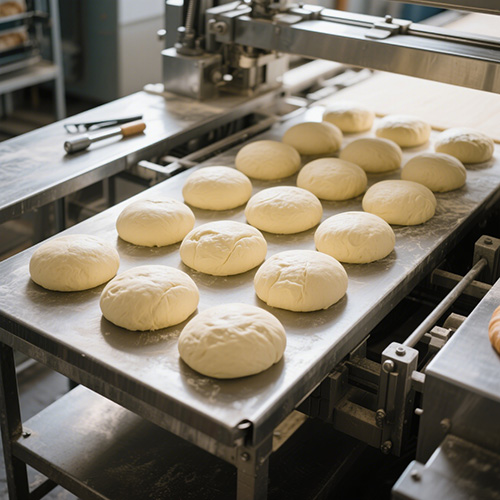

If you are planning to scale your bakery, central kitchen, or food processing facility, one thing becomes clear very quickly: manual dough handling cannot support consistent growth. As food machine manufacturers, we work closely with professional users every day, and we see the same challenge repeat itself—how to maintain dough quality while increasing output, reducing labor dependency, and meeting rising food safety expectations.
This is where dough machines move from being optional equipment to becoming the backbone of your production system.
In this in-depth guide, you will learn how modern dough machines are reshaping food production, what trends matter most right now, and how manufacturers design these machines to help you achieve stable quality, predictable costs, and long-term operational confidence.
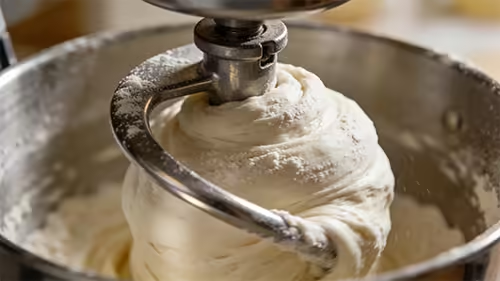
Dough preparation is not simply a mixing step. It directly affects texture, fermentation performance, volume, shelf life, and final product appearance. Inconsistent dough leads to waste, customer complaints, and unstable production planning.
According to publicly available data from industrial food processing studies published by organizations such as the Food and Agriculture Organization, automation in dough handling can reduce batch variability by more than 30 percent compared to manual processes when operating at scale.
From a manufacturer’s perspective, dough machines are designed to solve three core problems for you:
The popularity of dough machines is not accidental. Several industry-wide trends are accelerating adoption.
First, labor availability is becoming increasingly unstable in food production environments. Skilled dough handling requires experience, but staff turnover makes that expertise hard to retain. Machines provide repeatability regardless of who is operating them.
Second, food safety regulations and internal quality audits are becoming stricter. Automated dough machines reduce direct hand contact and support cleaner, more traceable production flows.
Third, diversified product lines are becoming the norm. Many facilities now produce multiple dough types in the same shift—soft dough, stiff dough, enriched dough, or laminated bases. Modern dough machines are designed to handle this flexibility without lengthy downtime.
Industry research summarized by Bakery & Snacks shows that bakeries adopting modular dough processing systems report faster product changeovers and improved scheduling accuracy.
From the outside, dough machines may look similar. From the manufacturing side, the engineering decisions behind them are highly intentional.
We design dough machines around real-world production pain points, not laboratory conditions. That means focusing on torque stability, dough temperature control, ease of sanitation, and operator usability.
A well-designed dough machine must maintain consistent energy transfer regardless of dough hydration level. This is why modern machines rely on optimized gear reduction systems and programmable mixing curves rather than simple speed control.
Another critical design factor is thermal management. Dough temperature rises during mixing, and uncontrolled heat can damage gluten structure. Manufacturers now integrate temperature sensors and mixing algorithms that limit friction heat buildup.
Understanding the main categories of dough machines helps you choose equipment that matches your production goals rather than over- or under-investing.
| Dough Machine Type | Best For | Production Advantage |
|---|---|---|
| Spiral Dough Machine | Bread and pizza dough | Strong gluten development with low heat |
| Horizontal Mixer | Cookies, pastries | Uniform blending of fats and inclusions |
| Fork Mixer | Artisan dough | Gentle mixing preserving dough structure |
| Continuous Dough System | Large-scale production | High throughput with minimal labor |
Each type exists because dough behaves differently under stress. As manufacturers, we advise customers to match dough rheology with machine mechanics instead of forcing one solution across all products.
One mid-scale food production facility approached us with a familiar issue. Their output targets had doubled, but customer feedback was becoming inconsistent. The dough texture varied noticeably between morning and evening batches.
After analyzing their workflow, we identified two root causes: inconsistent manual mixing times and temperature variation during peak hours.
The solution was not simply installing a larger machine. Instead, the facility implemented a programmable dough machine with torque-based mixing control and integrated dough temperature monitoring.
Within three months, batch rejection rates dropped by over 25 percent, and labor hours per unit decreased significantly. More importantly, customer complaints related to texture stabilized, allowing the company to confidently expand distribution.
This type of outcome is exactly why manufacturers focus on process-driven equipment design rather than raw motor power alone.
Sustainability is no longer a marketing term; it is an operational concern. Energy-efficient dough machines reduce long-term operating costs and support corporate responsibility goals.
Data shared by international energy research organizations indicates that optimized motor control systems can reduce energy consumption in food machinery by up to 20 percent compared to fixed-speed systems.
Manufacturers now integrate variable frequency drives, optimized mixing cycles, and low-friction transmission components. These features allow dough machines to deliver the same output using less energy, especially during partial loads.
For you, this means lower utility costs and easier compliance with sustainability audits.
A dough machine is not a short-term purchase. Its value depends on uptime, serviceability, and lifespan.
From a manufacturing standpoint, machines are now designed with modular components. Wear parts such as seals, bearings, and paddles are accessible without full disassembly. This reduces maintenance downtime and lowers service costs over time.
Regular preventive maintenance schedules, combined with proper operator training, can significantly extend machine lifespan. According to operational benchmarks published by Food Engineering Magazine, well-maintained dough machines often exceed their expected service life by several years.
Selecting a dough machine should begin with an honest assessment of your production reality.
Ask yourself how many dough types you produce, how frequently recipes change, and how much automation you realistically need. Over-automation can be just as costly as under-automation if it introduces unnecessary complexity.
From the manufacturer’s side, we encourage customers to evaluate equipment based on process compatibility rather than headline capacity. A slightly smaller machine optimized for your dough type often outperforms a larger machine used outside its ideal range.
Dough machines rarely operate alone. They are part of a wider ecosystem that includes dividing, rounding, proofing, and baking.
Manufacturers increasingly design dough machines to integrate seamlessly with upstream and downstream equipment. Standardized interfaces, synchronized controls, and consistent output characteristics reduce bottlenecks and improve line stability.
Industry integration practices outlined by food technology organizations emphasize that well-matched equipment lines outperform standalone upgrades in both efficiency and quality metrics.
Looking ahead, dough machines will continue evolving toward smarter control and deeper data integration. Predictive maintenance, recipe memory optimization, and remote diagnostics are already becoming standard features.
For you, this means machines that not only mix dough but actively support decision-making, reduce risk, and adapt to changing production demands.
From the manufacturer’s perspective, the goal is simple: build dough machines that grow with your business rather than limit it.
What capacity dough machine should I choose for my production volume?
The right capacity depends on batch frequency, dough type, and shift structure, not just daily output.
Are dough machines suitable for multiple dough recipes?
Yes, modern dough machines are designed with programmable controls to handle diverse formulations efficiently.
How does automation affect dough quality?
Properly designed machines improve consistency and reduce variability compared to manual mixing.
What maintenance is required for industrial dough machines?
Routine cleaning, lubrication, and periodic inspection of wear components are essential for long-term performance.
Can dough machines help reduce labor dependency?
Yes, automation stabilizes production even when skilled labor availability fluctuates.
If you are serious about scaling production while protecting product quality, dough machines are not just equipment—they are strategic assets. From a food machine manufacturer’s perspective, the most successful users are those who invest thoughtfully, align machinery with process needs, and view automation as a long-term partnership rather than a quick fix.
When chosen correctly, dough machines give you consistency, efficiency, and confidence in every batch you produce.