
Running a bakery efficiently requires more than passion and skilled bakers. The equipment you choose can make a substantial difference in consistency, speed, and product quality. Among these, the best dough maker plays a central role in ensuring your dough achieves perfect texture, elasticity, and uniformity every time.
In this guide, we’ll explore how to select the right dough maker, what features to prioritize, and how modern technology can elevate your bakery’s output. As a food equipment provider, Chengwo Food Machinery has worked with bakeries worldwide to implement solutions that reduce labor, improve consistency, and maximize efficiency.
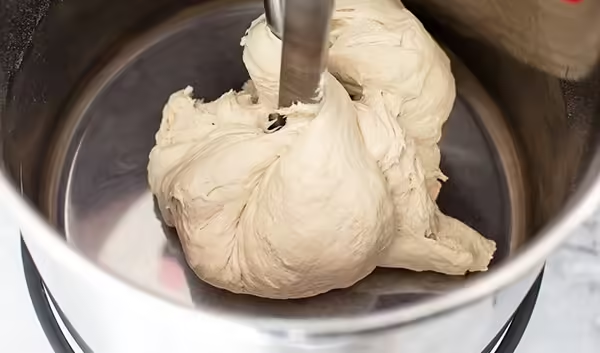
A dough maker is not just a mixer—it’s the foundation of quality baked goods. A commercial-grade dough maker automates the kneading process, providing the following:
For example, a mid-sized bakery producing 2,000 loaves per day found that upgrading to a commercial dough maker reduced kneading time from 20 minutes per batch to 8 minutes, freeing staff to handle packaging and customer orders.
When choosing a dough maker for commercial operations, consider these factors:
Choose a dough maker based on the size of your bakery and your production goals. For instance:
| Bakery Size | Batch Size (kg) | Recommended Dough Maker Capacity |
|---|---|---|
| Small (1–5 staff) | 5–20 | 10–30 kg |
| Medium (5–15 staff) | 20–50 | 30–60 kg |
| Large (15+ staff) | 50–150 | 60–200 kg |
Selecting a dough maker too small can slow production, while an oversized machine increases energy and maintenance costs unnecessarily.
Look for high-power motors capable of continuous operation. Stronger motors maintain dough consistency and reduce wear and tear. Stainless steel bowls and dough hooks are standard for long-term durability.
Modern dough makers feature the following:
Automation ensures you can reproduce recipes consistently, even with less experienced staff.
Hygiene is critical in food production. The best dough makers have detachable bowls, non-stick surfaces, and easy-to-access parts for daily cleaning.
Overload protection, emergency stop buttons, and enclosed mixing bowls reduce accidents and protect staff.
There are several types of commercial dough makers available:
| Dough Maker Type | Best For | Advantages | Limitations |
|---|---|---|---|
| Spiral Mixer | Bread, bagels | Excellent gluten development, fast | Larger footprint, higher cost |
| Planetary Mixer | Cakes, pastries, small batches | Versatile, compact | Slower for heavy dough |
| Twin-Shaft Mixer | High-volume industrial bakeries | Handles large batches, consistent | Requires skilled operators |
By comparing types, you can match the mixer to your bakery’s product mix and output needs.
A mid-sized bakery producing artisan breads faced challenges:
By integrating a spiral dough maker with a 60 kg batch capacity and automated mixing cycles, the bakery:
The ROI was achieved within six months due to increased efficiency and reduced waste.
To maximize the lifespan and efficiency of your dough maker:
Regular maintenance ensures your investment continues to pay off over years of production.
The best results come from integrating your dough maker with other bakery equipment:
An integrated system reduces handling, improves consistency, and allows your team to focus on quality control and finishing touches.
Modern dough makers are designed with energy efficiency in mind. Variable speed motors, heat-resistant materials, and optimized motor controls reduce electricity consumption. This is increasingly important as bakeries strive to meet environmental standards while lowering operating costs.
Even the best dough maker will underperform if not used correctly:
Avoiding these mistakes ensures maximum ROI and product consistency.
How do I know what size of the best dough maker I need?
Assess your daily production volume and the average batch size. Refer to manufacturer guidelines and consider future growth.
Can the best dough maker handle different types of dough?
Yes, but you need to match the mixer type (spiral, planetary, twin-shaft) with the dough type (bread, pastry, pizza).
How often should a commercial best dough maker be maintained?
Daily cleaning, weekly lubrication, and monthly inspections of motors and gears are recommended.
Are automated best dough makers energy-efficient?
Modern dough makers are designed with variable-speed motors and optimized controls to reduce electricity usage while maintaining performance.
What is the ROI of upgrading to a high-capacity dough maker?
Depending on production volume, labor savings, and reduced waste, bakeries can often recoup costs within 6–12 months.