
The bagel is perhaps the most demanding product in the entire baking world when it comes to mechanical mixing. With a typical hydration level hovering between 50 percent and 55 percent, bagel dough is notoriously stiff, dense, and resistant. For many standard kitchen mixers, this dough represents a breaking point, often leading to stripped gears or overheated motors. If you are a professional baker or an ambitious home enthusiast, finding the best bread kneading machine for bagels is not about looking at wattage; it is about understanding torque, heat dissipation, and structural integrity.
The physics of mixing low-hydration dough is significantly different from mixing a standard sandwich loaf or a high-hydration focaccia. When a machine attempts to move a heavy, dry mass of flour and water, the internal resistance creates a massive amount of back-pressure on the motor and the transmission. In standard planetary mixers, this often results in the head of the mixer “jumping” or the motor struggling to maintain a consistent RPM.
This mechanical stress is cumulative. Over time, the constant vibration and resistance cause micro-fractures in plastic gears or wear down the carbon brushes in universal motors. To truly master stiff dough, you need a machine designed to embrace this resistance rather than fight it.
When evaluating the best bread kneading machine for heavy-duty tasks, the motor type is your primary consideration. Direct Current (DC) motors are generally superior for bagels because they provide maximum torque at low speeds. Unlike alternating current (AC) motors, which often need to spin fast to stay cool, a high-quality DC motor can maintain a slow, powerful churn without losing strength.
The transmission is the second pillar of performance. Look for all-metal gear systems or reinforced belt drives. According to internal engineering stress tests conducted by industrial equipment manufacturers, all-metal transmissions can handle up to 40 percent more torque than hybrid plastic-metal systems before failure occurs. This durability is what ensures your machine will still be functioning a decade from now.
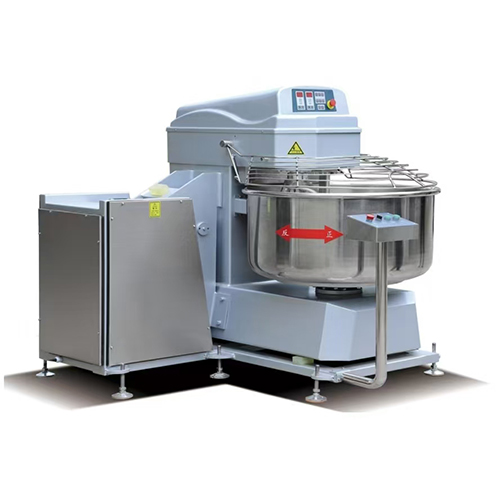
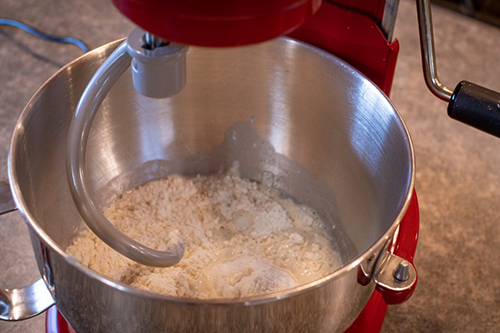
For stiff dough, the spiral mixer is almost always the best bread kneading machine choice. In a planetary mixer, the bowl remains stationary while the attachment moves around it. This is excellent for whipping cream or mixing cake batter, but it creates uneven stress when handling bagel dough.
In contrast, a spiral mixer rotates the bowl while the spiral hook remains in a fixed position. This dual-rotation movement significantly reduces the friction factor. Because the dough is constantly being pushed against a central breaker bar, it develops gluten more efficiently and with less mechanical strain on the motor.
The following table compares how different mixer configurations handle the specific stresses of bagel dough production.
| Feature | Household Stand Mixer | Professional Planetary Mixer | Industrial Spiral Mixer |
| Motor Type | Universal (AC) | Induction (AC/DC) | High-Torque DC / Induction |
| Gear Material | Plastic or Hybrid | All-Metal | All-Metal / Heavy Duty Belt |
| Heat Generation | High (Friction & Motor) | Medium | Low (Synchronized Rotation) |
| Stiff Dough Limit | 0.5 kg – 1.0 kg | 1.5 kg – 3.0 kg | 5.0 kg – 50.0 kg+ |
| Gluten Development | 12 – 15 Minutes | 10 – 12 Minutes | 6 – 8 Minutes |
Heat is the enemy of high-quality bread. As a mixer works through a stiff dough, friction naturally increases the temperature of the dough mass. If the temperature exceeds 26 degrees Celsius (78 degrees Fahrenheit) during the mix, the yeast may activate too early, leading to a poor rise and a lack of flavor development.
The best bread kneading machine models incorporate active or passive cooling systems. Heavy cast-aluminum or stainless-steel housings act as natural heat sinks, drawing warmth away from the motor. Some professional-grade spiral mixers even include dedicated cooling fans to ensure the duty cycle can remain at 100 percent, allowing you to mix batch after batch without a mandatory cool-down period.
If you have ever seen a mixer start to move across a counter while mixing, you are witnessing a lack of stability. Stiff dough creates centrifugal forces that want to pull the machine off its base. Net weight is a crucial metric here. A professional-grade machine for bagels should be heavy—often weighing between 25 and 50 kilograms. This mass acts as an anchor, absorbing vibrations and ensuring that the internal gears remain perfectly aligned even under maximum load.
Effective kneading is about more than just power; it is about control. The best bread kneading machine should offer variable speed settings. For bagels, you typically start at a very low speed to incorporate the flour and water without creating a “flour cloud.” Once the shaggy mass forms, you move to a second, slightly faster speed to develop the gluten matrix. Precise timing controls are also vital for consistency. In a commercial environment, being able to set a digital timer for exactly seven minutes ensures that every batch of bagels has the same chew and crust characteristics.
One common mistake is buying a machine that is too large for your typical needs. Mixers have a minimum flour load requirement. If you try to mix 500 grams of flour in a 20-quart bowl, the hook will simply move the flour around without actually kneading it. Conversely, overloading a machine is the fastest way to void your warranty. For a small commercial studio, a 10-liter or 20-liter spiral mixer is often the sweet spot, providing enough capacity for a full tray of bagels while still being efficient for smaller specialty batches.
Finally, the best bread kneading machine is one that is easy to maintain. Look for models with removable bowls or heads that lift, as this makes sanitation much simpler. Stiff dough can get into small crevices, and if left to dry, it can become as hard as concrete. Regularly greasing the internal bearings with food-grade lubricant and checking the tension on the drive belts will keep your machine running smoothly. A well-maintained professional mixer does not just make better bread; it retains its resale value and provides a reliable foundation for your baking business.
Choosing the best bread kneading machine is a decision that directly influences the texture, crumb structure, and shelf life of your final product. When dealing with the intense resistance of stiff doughs like bagels, the technical specifications of your equipment move from being a matter of convenience to a matter of necessity. A machine that offers high torque, efficient heat dissipation, and a stable, heavy-duty chassis ensures that you can produce professional-grade bread consistently without risking mechanical failure.
Can I use a standard kitchen stand mixer for daily bagel production?
While you can occasionally mix a small batch of bagel dough in a high-end kitchen mixer, doing so daily will eventually lead to mechanical failure. Standard mixers are designed for higher-hydration doughs. For consistent bagel production, a dedicated spiral mixer with a DC motor is highly recommended.
How many minutes should I knead bagel dough in a professional spiral mixer?
Due to the efficiency of the spiral hook and bowl rotation, most bagel doughs reach full gluten development in 6 to 9 minutes. It is important to monitor the dough temperature during this time to ensure it does not exceed 26 degrees Celsius.
Is a 5-quart capacity enough for a home-based bagel business?
A 5-quart mixer is generally too small for a commercial venture. It can typically handle about 1 to 1.5 kilograms of stiff dough at once. For a business, you would want a minimum of an 8-quart or 10-liter machine to ensure you can produce meaningful quantities efficiently.
If you’re unsure about which best bread kneading machine is best for your bakery or home studio, our experts are here to help. Contact us today for a personalized consultation, and ensure your baking equipment is reliable, high-performing, and built to handle the toughest doughs. Don’t wait until your current mixer fails—get in touch now to upgrade your kitchen and perfect your bagel recipe!