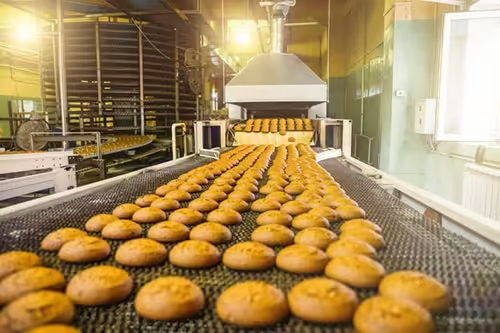

If you are producing filled bread products today, you are probably facing a difficult balance between consistency, labor cost, product appearance, and output speed. Consumers increasingly expect uniform filling distribution, stable taste, and attractive appearance. At the same time, labor availability and training costs continue to rise.
This is exactly where an automatic filling bread production line becomes a strategic investment rather than just another equipment purchase.
As a food equipment manufacturer, we have seen a clear shift in bakery production priorities. Bakeries are moving away from semi-manual filling and shaping processes toward integrated automation systems that can handle dough dividing, filling injection, forming, proofing preparation, and tray loading in one continuous workflow.
You are no longer just buying a machine. You are building a production system that determines your product quality, cost structure, and expansion potential for years.
The growth of filled bread products is strongly connected to convenience food trends, ready-to-eat bakery items, and premium stuffed bread categories. Industry production data published by global food manufacturing research organizations shows that filled bakery products have maintained steady growth due to higher perceived value and product differentiation potential.
From an operational perspective, filled bread production is more complex than standard bread production. You must manage:
• Dough consistency
• Filling viscosity stability
• Injection accuracy
• Sealing quality
• Shape retention during proofing
• Baking expansion uniformity
Without automation, these variables create high rejection rates and inconsistent customer experience.
An automatic filling bread production line is designed to integrate multiple production stages into one synchronized workflow.
Typical process stages include:
Dough mixing and resting
Dough dividing and rounding
Filling injection or filling wrapping
Dough forming and shaping
Pan or tray arrangement
Transfer to proofing stage
Transfer to baking stage
The key benefit is synchronization. When each stage communicates electronically, production flow remains stable and predictable.
When evaluating an automatic filling bread production line, you should focus on the components that directly affect production stability.
Controls dough weight accuracy and stress level during forming. Poor dough handling creates filling leakage risks later.
High precision servo filling pumps allow consistent filling volume per product.
Ensures filling stays centered and dough seals properly, preventing bursting during proofing or baking.
Allows you to adjust product weight, filling ratio, forming speed, and production rhythm.
Below is a realistic comparison showing how automation changes filled bread production performance.
| Production Mode | Workers Required | Output Per Hour | Filling Accuracy | Product Consistency | Waste Rate |
|---|---|---|---|---|---|
| Manual Filling | 6-8 | 800-1200 pcs | Medium | Medium | 6-10% |
| Semi Automatic | 3-4 | 1500-2500 pcs | Good | Good | 3-5% |
| Automatic Filling Bread Production Line | 1-2 | 4000-8000 pcs | Very High | Very High | <2% |
These values reflect typical industrial production observations across multiple bakery environments.
One mid-sized bakery producing filled sweet buns faced three major challenges:
• Filling leakage during proofing
• High labor dependency
• Inconsistent product weight
After installing an automatic filling bread production line, they achieved:
Production increase from 1,200 pcs/hour to 5,200 pcs/hour
Labor reduction by 60 percent
Filling deviation reduced to less than ±2 grams
Customer complaint rate dropped significantly
The biggest improvement was production predictability. You can plan output with much greater accuracy.
Filling consistency is one of the hardest parts of filled bread production. Manual filling creates variation based on operator fatigue and skill level.
Servo filling systems provide:
Stable injection pressure
Precise filling positioning
Adjustable filling patterns
Real-time volume monitoring
For premium bakery products, visual consistency is just as important as taste consistency.
You may initially focus on equipment cost, but long-term operational cost reduction is where real value appears.
Major cost reductions typically include:
Labor cost
Training cost
Material waste
Product rejection rate
Quality inspection time
Many bakeries achieve full ROI within 18–36 months depending on production volume.
You should evaluate based on:
Target hourly output
Filling type and viscosity
Product shape variety
Floor space availability
Integration with existing mixers and ovens
Future product expansion plans
The biggest mistake is choosing equipment based only on current production volume rather than projected growth.
The next generation of automatic filling bread production line systems focuses on:
AI-assisted production parameter optimization
Energy consumption monitoring
Predictive maintenance alerts
Remote production monitoring
Quick product changeover technology
Automation is shifting from mechanical automation to data-driven automation.
Preparation steps include:
Standardizing dough formulation consistency
Training operators on digital control systems
Planning production layout optimization
Preparing stable power supply and environment control
Factories that prepare early typically achieve faster production ramp-up.
Choosing lowest price instead of lifecycle cost
Ignoring future product expansion needs
Underestimating filling material behavior
Not planning for operator training
The right equipment should support your next five years of growth, not just current production.
An automatic filling bread production line is not just about increasing speed. It is about stabilizing product quality, reducing operational risk, and building a production system that allows you to scale without losing control over consistency.
If you want to compete in modern bakery production, automation is no longer optional. It is the foundation of sustainable growth.
How many products can an automatic filling bread production line produce per hour?
Most industrial systems produce between 3000 and 8000 pieces per hour depending on product size and filling type.
Can the line handle different filling types?
Yes. Modern systems can handle cream, paste, jam, chocolate filling, and some meat-based fillings depending on viscosity.
How difficult is it to operate an automatic filling bread production line?
Most modern systems use touchscreen control with recipe memory, making operation easier than older mechanical systems.
How long does installation and training take?
Typical installation and training takes 5 to 14 days depending on line complexity.
How do I know if automation is worth the investment?
If you are facing labor shortages, inconsistent filling quality, or production bottlenecks, automation usually provides strong ROI.