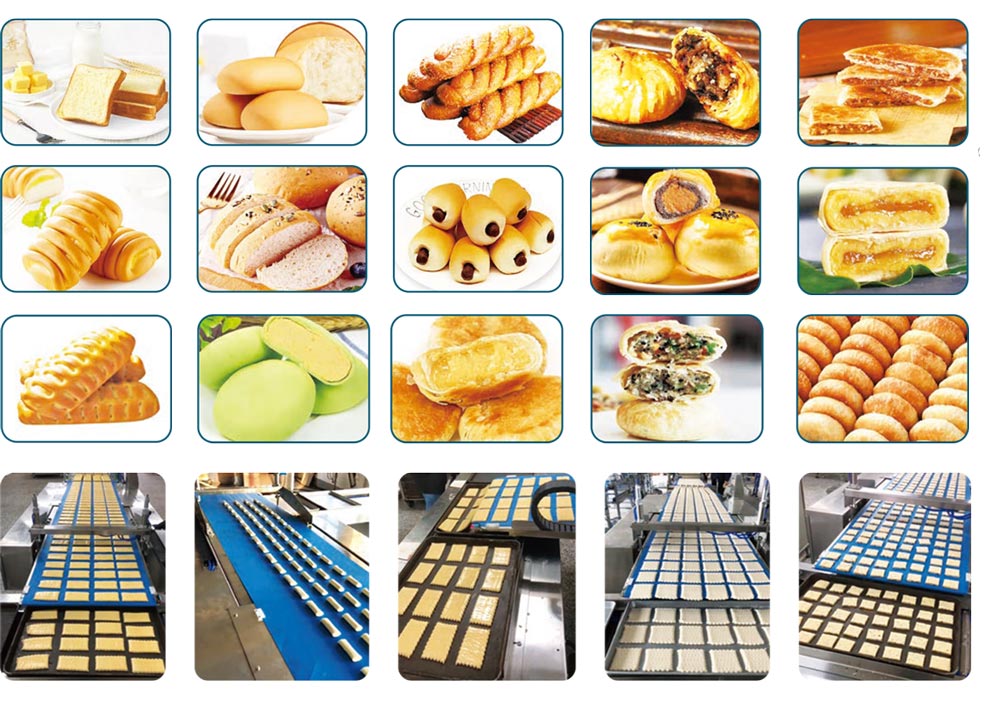

The modern bakery landscape has evolved dramatically. Customer preferences shift rapidly, seasonal demands fluctuate unpredictably, and competitive pressures demand both product diversity and operational efficiency. For bakery owners and production managers, the traditional approach of dedicating separate equipment to each product category has become increasingly impractical.
The solution lies in flexible production lines capable of manufacturing multiple product types on a single integrated system. This comprehensive guide explores how modern bakery equipment can produce bread, pastry, and pizza products efficiently, enabling bakeries to expand their product offerings, optimize resource utilization, and respond swiftly to market demands without duplicating investments in multiple specialized production lines.
Investing in specialized equipment for each product category represents a significant capital commitment that may not align with actual production volumes. A dedicated bread line operating at full capacity during morning shifts may sit idle during afternoon pastry production hours. Similarly, a pizza line optimized for evening service may remain dormant during morning bakery operations.
Multi-product production lines address this inefficiency by enabling equipment to serve multiple purposes throughout the production day. This approach maximizes return on investment by increasing equipment utilization rates from 40-50% (typical for single-product lines) to 75-85% (achievable with flexible multi-product systems). Higher utilization directly improves profitability by spreading fixed equipment costs across more production hours and product categories.
Commercial bakery space represents a premium operational expense. Installing three separate production lines for bread, pastry, and pizza can require 200-400 square meters of additional floor space, depending on capacity requirements. Multi-product lines consolidate these functions into a smaller footprint, typically requiring 30-40% less space than equivalent single-product installations.
This space efficiency is particularly valuable for urban bakeries, central kitchens with limited floor area, and operations planning to expand product offerings without relocating facilities. Reduced space requirements also translate to lower construction costs, simplified workflow design, and easier maintenance access.
Operating multiple specialized lines requires maintaining distinct skill sets for each product category. Bread production expertise differs from pastry handling techniques and pizza dough management requirements. Training and retaining qualified staff for each specialized area increases labor complexity and costs.
Multi-product production lines enable cross-training across product categories, allowing operators to develop versatile skill sets. A single team can manage production transitions from bread to pastry to pizza, reducing staffing requirements while maintaining operational flexibility. This approach simplifies scheduling, reduces training costs, and creates more engaging work opportunities for employees through task variety.
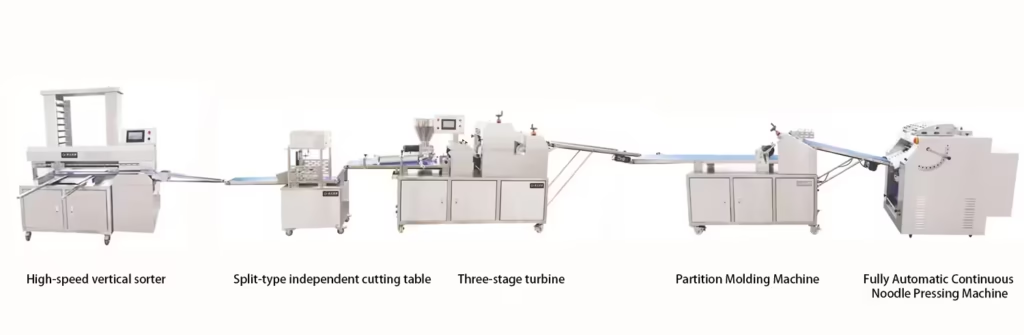
Bread production lines represent the backbone of most bakery operations, characterized by high-volume continuous processing capabilities. Modern bread lines integrate multiple automated functions: dough sheeting, dividing, rounding, intermediate proofing, molding, and automatic tray arrangement.
The core components typically include:
Continuous Pressing Systems: Multi-roller arrangements (typically three pressing stages) progressively reduce dough thickness from initial chunk consistency to final sheet specifications. First-stage pre-pressing rollers handle initial thickness reduction, while second-stage multi-roller thinning units (often 12-roller configurations) achieve precise thickness control. Third-stage leveling rollers ensure uniform sheet thickness for downstream processing.
Filling and Forming Stations: Integrated depositing systems enable production of stuffed bread products such as honeycomb buns, caterpillar breads, filled burgers, and sweet buns. These stations can be configured for various filling types—sweet, savory, and combinations—allowing rapid product line expansion.
Independent Cutting Systems: Separated cutting stations allow dough sheets to relax before portioning, resulting in more accurate weight control and consistent product dimensions. This separation also accommodates different cutting patterns for various product shapes without interrupting production flow.
High-Speed Arranging Equipment: Vertical high-speed arranging machines organize finished products onto trays or conveyor systems with precision placement rates up to 15,000 pieces per hour. Advanced models feature intelligent spacing algorithms that optimize tray utilization while maintaining product integrity.
Production capacities for bread lines typically range from 1,000 to 15,000 pieces per hour, with final product weights adjustable from 15 to 500 grams per piece. The main frame construction utilizes all-stainless steel materials precisely cut with large-scale lasers and welded for stability, robustness, safety, and hygiene.
Control systems employ programmable logic controllers (PLC) with photoelectric sensors for dough sheet management and touch-screen interfaces for modern automated human-machine interaction. Parameter memory functions enable quick product changeovers by recalling saved settings for different product configurations.
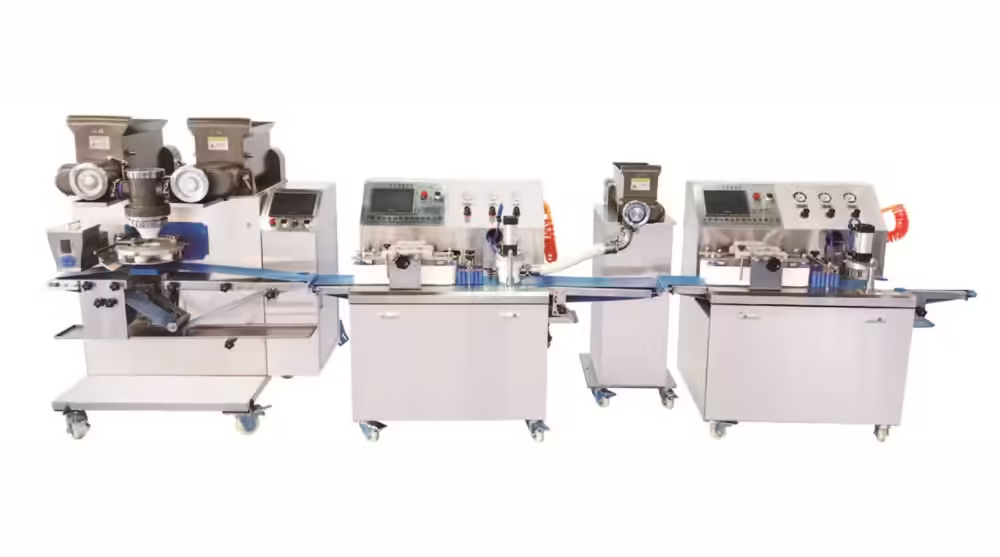
Pastry production demands exceptional precision in portioning and forming, particularly for products with complex fillings and delicate structures. Modern pastry lines excel at producing mooncakes, mochi, cakes, cookies, and similar items with consistent quality and high production efficiency.
Key features of pastry production systems include:
Precision Encrusting Technology: Square-bucket quantitative systems deliver accurate portion control for products ranging from 15 to 650 grams per piece. These systems handle both dry and sticky fillings with equal reliability, accommodating the diverse ingredient characteristics common in pastry production. Advanced models feature multiple filling stations for layered or multi-component products.
Integrated Forming Systems: Forming machines shape encrusted products into various configurations—round, rectangular, oval, and custom shapes—without damaging delicate fillings or dough structures. The forming process incorporates gentle handling techniques that preserve product integrity while achieving consistent dimensions across high-volume production runs.
Automated Arrangement Solutions: Arranging systems automatically transfer formed products onto trays or baking sheets with precise positioning, ensuring uniform baking and presentation. These systems can accommodate various tray sizes and patterns, allowing bakeries to optimize oven utilization and product presentation.
Pastry line capacities typically range from 1,000 to 5,000 pieces per hour, with power requirements distributed across multiple stations: encrusting machines (2.4KW), forming machines (0.6KW), and arranging machines (2.2KW). Total system weights range from 890 to 3,200 kilograms depending on configuration and capacity.
The modular construction enables easy cleaning and maintenance, critical for pastry production where ingredient residue and cross-contamination concerns are paramount. Removable components, tool-free disassembly, and washable surfaces simplify sanitation procedures and reduce downtime between production runs.
Pizza production lines focus on achieving consistent dough handling, precise portioning, and uniform baking characteristics—essential elements for delivering consistent quality across high-volume pizza operations. These systems integrate dough preparation, portioning, shaping, topping application, and baking into seamless production workflows.
Core pizza production line capabilities include:
Dough Handling Systems: Automated dough receiving, conditioning, and portioning systems ensure consistent dough characteristics for every pizza base. Temperature-controlled conditioning chambers maintain optimal dough properties, while volumetric or weight-based portioning systems deliver consistent dough ball weights with minimal variance.
Shaping and Forming Equipment: Pressing systems flatten dough portions into uniform thicknesses adjustable for different pizza styles—thin crust, thick crust, deep dish, and specialty formats. Advanced models incorporate edge-forming capabilities that create raised crust edges automatically, ensuring consistent presentation across production volumes.
Automated Topping Application: Sauce spreading systems apply precise sauce quantities with uniform coverage, while cheese dispensing systems distribute cheese evenly across the pizza surface. Topping stations can accommodate various ingredient types—vegetables, meats, and specialty items—with adjustable dispensing rates and patterns.
Pizza production lines are designed for efficient production with precise control of dough handling and baking processes, ensuring uniform taste and stable quality for every pizza suitable for various commercial needs. The emphasis on consistency makes these systems ideal for chain operations, central production facilities, and high-volume pizzerias where product uniformity directly impacts brand reputation and customer satisfaction.
Designing production lines that accommodate multiple product types requires careful consideration of several engineering principles:
Modular Component Design: Individual stations—mixing, dividing, forming, baking, and cooling—should be interchangeable and independently controllable. This modularity enables rapid reconfiguration when transitioning between product types without requiring complete line replacement or major structural modifications.
Adjustable Speed and Capacity Controls: Variable speed drives and adjustable capacity settings allow equipment to operate at optimal parameters for different product types. Bread production may require higher throughput rates, while pastry processing often demands slower, more precise handling. Adjustable controls ensure each product category receives appropriate processing conditions.
Universal Handling Systems: Conveyor systems, transfer mechanisms, and product handling equipment should accommodate various product sizes, shapes, and weights. Adjustable guide rails, variable-width conveyors, and programmable transfer systems enable seamless transitions between product categories.
Integrated Cleaning Protocols: Production changeovers require thorough cleaning to prevent cross-contamination between product types, particularly when transitioning from savory to sweet products or between allergen-containing and allergen-free formulations. Integrated cleaning systems with accessible cleaning points and CIP (clean-in-place) capabilities minimize changeover downtime.
Effective multi-product production requires sophisticated scheduling strategies that balance efficiency with flexibility:
Batch Grouping Strategies: Similar products requiring similar processing conditions should be grouped in production runs to minimize changeover frequency. For example, all bread products could be produced consecutively, followed by all pastry items, then all pizza products. This approach reduces the number of major line reconfigurations required daily.
Transition Sequencing: Product transitions should be planned to minimize cleaning and setup requirements. Transitions from neutral products (plain bread) to flavored products (herb bread) require less extensive cleaning than transitions between strongly contrasting flavors (garlic bread to vanilla pastry). Intelligent sequencing reduces changeover time and cleaning costs.
Capacity Buffering: Production schedules should include capacity buffers to accommodate unexpected demand surges, equipment maintenance, or production complications. These buffers prevent bottlenecks and ensure consistent product availability across all product categories.
Real-Time Monitoring Systems: Production monitoring systems track equipment performance, product quality metrics, and line efficiency in real time. This visibility enables rapid response to production issues, scheduling adjustments, and resource reallocation to maintain optimal production flow.
Minimizing changeover time between product types is critical for multi-product line efficiency:
Standardized Changeover Procedures: Documented, step-by-step changeover protocols ensure consistency and reduce changeover time variability. Standard procedures also facilitate training and enable cross-functional team members to execute changeovers reliably.
Tool-Free Adjustment Mechanisms: Quick-release mechanisms, tool-free adjustment points, and color-coded components simplify line reconfiguration. These features reduce changeover time from hours to minutes and decrease dependency on specialized technical personnel.
Pre-Configured Tool Sets: Dedicated tool sets for each product category—cutting dies, forming molds, conveyor guides—can be pre-staged and swapped quickly between production runs. This preparation eliminates searching for components and ensures correct tools are available when needed.
Automated Changeover Systems: Advanced production lines incorporate automated changeover capabilities where equipment settings, dimensions, and parameters adjust automatically based on pre-programmed recipes. These systems can reduce changeover time by 70-80% compared to manual procedures.
Modern multi-product production lines rely on programmable logic controllers (PLC) to coordinate complex production sequences across multiple product types. PLC systems offer several advantages:
Recipe Management: Production parameters for each product type can be stored as digital recipes, enabling instant recall of optimal settings for bread, pastry, and pizza products. Recipe databases can contain hundreds of product configurations, supporting extensive product variety without manual parameter entry.
Automated Sequencing: PLC systems coordinate operation sequencing across all line components, ensuring stations operate in proper order and timing. This coordination prevents bottlenecks, optimizes throughput, and maintains product quality consistency.
Real-Time Monitoring: Production metrics—temperature, speed, throughput, product counts—are monitored continuously and displayed on operator interfaces. This real-time visibility enables rapid response to production issues and facilitates quality control.
Data Logging and Analysis: Production data can be logged for subsequent analysis, enabling continuous improvement, trend identification, and predictive maintenance scheduling. Historical data analysis supports capacity planning, production optimization, and quality enhancement initiatives.
Advanced sensor technology enables precise quality control across diverse product types:
Photoelectric Sensors: Dough sheet position and movement are monitored using photoelectric sensors, ensuring precise tracking through various processing stages. These sensors enable automatic speed adjustments to maintain optimal processing conditions.
Weight Measurement Systems: Inline weighing systems verify product weights against target specifications, providing immediate feedback for portioning adjustments. Real-time weight control reduces product giveaway and ensures consistent product specifications.
Temperature Monitoring: Dough temperature, oven temperatures, and product cooling rates are monitored throughout production processes. Temperature control is particularly critical for dough-based products where temperature affects fermentation, texture, and final product quality.
Vision Inspection Systems: Optical inspection systems verify product dimensions, surface characteristics, and visual quality attributes. These systems can detect defects, verify topping coverage, and ensure product presentation standards across all product categories.
Multi-product production lines require careful attention to hygiene design, particularly when processing both sweet and savory products or managing allergen concerns:
Stainless Steel Construction: Food-grade stainless steel (typically 304 or 316 grades) provides corrosion resistance, durability, and compatibility with food-contact requirements. All-stainless construction facilitates cleaning and maintains sanitary conditions across repeated production cycles.
Smooth Surface Design: Equipment surfaces should be smooth, free of crevices and dead spaces where food residue can accumulate. Rounded corners, seamless welds, and polished surfaces minimize bacterial harborage points and simplify cleaning procedures.
Accessible Design: Critical components—contact surfaces, cutting blades, forming surfaces—should be readily accessible for cleaning, inspection, and maintenance. Removable panels, quick-release mechanisms, and tool-free disassembly simplify routine sanitation procedures.
Drainage and Fluid Management: Equipment design should facilitate complete drainage and prevent fluid accumulation. Sloped surfaces, drainage channels, and waterproof electrical components ensure thorough cleaning and prevent water damage.
Effective cleaning protocols are essential for preventing cross-contamination between product types:
Product-Specific Cleaning Procedures: Different product types require different cleaning approaches. Sweet pastry residues may require different cleaning agents than savory bread residues. Product-specific procedures ensure effective cleaning while protecting equipment from inappropriate chemical exposure.
Validation and Verification: Cleaning effectiveness should be validated through visual inspection, microbiological testing, and residue detection methods. Verification procedures confirm that cross-contamination risks are adequately controlled before initiating production of different product categories.
Allergen Management: When producing both allergen-containing and allergen-free products, additional precautions are necessary. Dedicated production sequences, enhanced cleaning protocols, and allergen testing ensure consumer safety and regulatory compliance.
Documentation and Traceability: Cleaning activities should be documented with timestamps, cleaning agents used, personnel responsible, and verification results. This documentation supports regulatory compliance, quality management, and traceability requirements.
When evaluating multi-product versus single-product production line investments, several factors require consideration:
Initial Equipment Cost: Multi-product lines typically have higher initial costs than single-product lines due to enhanced flexibility features, modular design, and advanced control systems. However, total investment for three separate single-product lines often exceeds the cost of one comprehensive multi-product system by 50-100%.
Installation and Commissioning: Multi-product lines may require more complex installation processes due to integrated systems and sophisticated controls. However, this complexity is offset by reduced infrastructure requirements—single electrical service, compressed air supply, and facility preparation—compared to multiple separate installations.
Facility Requirements: Floor space requirements for multi-product lines are significantly lower than equivalent single-product installations, reducing construction costs, lease expenses, and facility expansion requirements. Space savings can be particularly valuable in urban locations where real estate costs are substantial.
Operating costs for multi-product production lines reflect efficiency gains from higher equipment utilization:
Labor Efficiency: Multi-product lines reduce staffing requirements through consolidated operations and simplified workflow. Cross-trained operators can manage multiple product types, reducing headcount requirements compared to separate specialized teams for each product category.
Energy Consumption: While multi-product lines may have higher power ratings than individual single-product lines, total energy consumption is often lower due to reduced idle time and optimized production scheduling. Continuous operation across product categories maintains consistent energy utilization rather than start-终止 cycles typical of specialized lines.
Maintenance Expenses: Consolidated equipment reduces maintenance requirements compared to multiple separate systems. However, multi-product lines may experience higher wear due to more frequent use and diverse processing demands. Predictive maintenance programs help balance these factors and optimize maintenance scheduling.
Changeover Costs: Transitioning between product types incurs changeover costs including cleaning time, setup time, and production startup losses. Efficient changeover procedures minimize these costs, but they represent an ongoing operational consideration not present in dedicated single-product lines.
Multi-product production capabilities create revenue enhancement opportunities:
Product Line Expansion: Production flexibility enables bakeries to introduce new products without additional equipment investment. Seasonal offerings, specialty items, and customer-requested products can be added to production schedules, increasing revenue potential.
Market Responsiveness: Ability to quickly adjust production mix in response to demand shifts captures sales opportunities that would be lost with inflexible single-product systems. Bakery operators can allocate production capacity to high-margin products when demand patterns change.
Customer Acquisition: Broader product portfolios attract diverse customer segments and support multiple market channels. Retail bakery customers, food service accounts, and wholesale distributors each require different product types—multi-product production enables serving all markets effectively.
Successful implementation of multi-product production lines requires thorough planning:
Product Portfolio Analysis: Comprehensive analysis of current and planned product requirements identifies essential production capabilities. Bread varieties, pastry types, and pizza formats should be catalogued with production volumes, processing requirements, and quality specifications.
Capacity Planning: Production capacity requirements for each product category determine equipment sizing and configuration. Peak demand periods, growth projections, and seasonal variations should be considered to ensure adequate capacity without excessive overprovisioning.
Workflow Design: Production workflow should be optimized for efficient transitions between product types. Equipment arrangement, material flow patterns, and operator positioning should facilitate smooth production transitions while maintaining efficiency.
Technology Selection: Equipment technology selection should balance flexibility, performance, and cost. Modular designs, automated controls, and advanced features enhance capabilities but increase investment. Technology selection should align with business requirements and financial constraints.
Proper installation and commissioning ensure optimal system performance:
Infrastructure Preparation: Electrical supply, compressed air systems, drainage, and facility modifications should be completed according to equipment specifications. Infrastructure capacity must support peak operational requirements across all product categories.
Equipment Installation: Professional installation following manufacturer guidelines ensures proper alignment, calibration, and integration of system components. Installation procedures should verify equipment performance against specifications before proceeding to commissioning.
Operator Training: Comprehensive training programs enable operators to effectively utilize multi-product production capabilities. Training should cover equipment operation, product changeover procedures, quality control methods, and troubleshooting techniques.
Production Validation: Initial production runs validate equipment performance across all product categories. Product quality, production efficiency, and changeover procedures should be tested and optimized before full-scale production deployment.
Continuous optimization ensures sustained performance:
Performance Monitoring: Regular monitoring of production metrics identifies improvement opportunities. Key performance indicators include throughput rates, product quality, changeover times, and equipment utilization.
Maintenance Programs: Preventive maintenance programs prevent unplanned downtime and extend equipment life. Maintenance schedules should consider usage intensity across diverse product types and adjust maintenance intervals accordingly.
Product Development Integration: New product development should consider production line capabilities and limitations. Collaboration between product development and production teams ensures new products can be efficiently produced using existing equipment.
Technology Upgrades: Periodic technology upgrades enhance capabilities and extend equipment life. Component upgrades, software updates, and automation enhancements keep production systems current with evolving requirements and technologies.
The next generation of multi-product production lines will incorporate advanced Industry 4.0 technologies:
Internet of Things (IoT) Connectivity: Equipment components will feature embedded sensors and IoT connectivity enabling real-time data collection, predictive maintenance, and remote monitoring capabilities. This connectivity will enhance equipment reliability and optimize performance across diverse product types.
Artificial Intelligence Optimization: AI algorithms will optimize production scheduling, changeover sequencing, and parameter settings across product categories. Machine learning systems will continuously improve based on production data and performance feedback.
Digital Twin Technology: Virtual representations of physical production lines will enable simulation and optimization before implementing changes. Digital twins will support product development, production planning, and process improvement initiatives.
Cloud-Based Control Systems: Cloud-based control platforms will enable remote monitoring, centralized management of multiple production facilities, and real-time collaboration across organizational functions. These systems will enhance operational visibility and decision-making capabilities.
Future multi-product production lines will emphasize sustainability:
Energy Efficiency: Advanced motor technologies, regenerative braking systems, and intelligent power management will reduce energy consumption. Energy recovery systems will capture and reuse thermal and mechanical energy where possible.
Resource Optimization: Precise portioning, reduced waste generation, and ingredient optimization will minimize resource consumption. Advanced monitoring systems will identify waste sources and enable targeted improvement initiatives.
Water Conservation: Efficient cleaning systems, water recycling capabilities, and intelligent water management will reduce water consumption. These systems will maintain hygiene standards while minimizing environmental impact.
Sustainable Materials: Equipment construction will increasingly incorporate recycled materials and sustainable components. End-of-life recyclability and material recovery will influence equipment design and material selection.
Multi-product production lines represent the future of flexible bakery manufacturing. By integrating capabilities for bread, pastry, and pizza production into single cohesive systems, bakeries can achieve unprecedented operational efficiency, product diversity, and market responsiveness. The technology enables bakeries to adapt quickly to changing consumer preferences, optimize resource utilization, and maximize return on capital investments.
Successful implementation requires careful planning, thoughtful equipment selection, and ongoing optimization. However, the benefits—enhanced flexibility, improved efficiency, expanded product capabilities, and strengthened competitive position—make multi-product production lines an increasingly attractive option for modern bakery operations seeking sustainable growth and market leadership.
As bakery technology continues evolving, multi-product production lines will incorporate advanced automation, intelligent controls, and sustainability features that further enhance performance and capabilities. Bakeries that embrace this technology today will be well-positioned to capitalize on future opportunities and maintain competitive advantage in an increasingly dynamic market environment.
What types of products can CWBakemech’s flexible production lines handle?
Our integrated system produces a wide range including bread (artisan loaves, buns, toast), pastries (mooncakes, mochi, filled cakes), and pizza (thin/thick crust bases, flatbreads). The modular design supports over 20 product categories with quick changeover between lines, enabling bakeries to expand their product offerings without additional equipment investment.
How quickly can the production line switch between different products?
The system achieves product changeovers in as little as 30 minutes, 67% faster than industry average, through tool-less component changes and recipe-driven automation. This enables efficient transitions from morning bread production to afternoon pastry runs and evening pizza service within the same production day.
What is the production capacity range of these integrated lines?
Capacity scales from 5,000 to 20,000+ pieces daily. The bread line alone handles 1,000-15,000 pcs/h, pastry line 1,000-5,000 pcs/h, with pizza production matching demand through flexible oven configurations. Production capacity can be adjusted based on seasonal demand and market requirements.
How much space does an integrated bakery production line require?
Our compact design needs 75-160 m² depending on configuration—40% less space than three separate lines. A typical mid-capacity setup (10,000 pcs/day) occupies approximately 110 m², making it ideal for urban bakeries and central kitchens with limited floor space.
If you’re unsure which production configuration best fits your bakery’s product mix, capacity requirements, and growth plans, our experts are here to help. Contact us today for a personalized consultation, and discover how flexible multi-product production lines can transform your operation. Don’t compromise on flexibility—get in touch now to explore solutions that grow with your business!