

Running an industrial bakery efficiently requires more than skilled bakers—it relies heavily on the right equipment. The choice of machinery directly impacts production speed, consistency, and product quality. From mixers to ovens and dough dividers, selecting suitable equipment ensures your bakery operates at maximum efficiency while maintaining high standards. This guide explores essential industrial bakery equipment, providing insights for both new and experienced bakery operators.
Mixing is the foundation of any bakery operation. Industrial bakeries rely on robust mixers that can handle large batches of dough while maintaining consistent texture.
Planetary Mixers are versatile and ideal for dough, batters, and sauces. They come with multiple speed settings and attachments, allowing bakers to prepare different recipes efficiently.
Spiral Mixers specialize in high-hydration dough like pizza and bread, producing smooth and elastic dough quickly.
Floor Mixers cater to very high-volume production, suitable for commercial bakeries producing hundreds of loaves daily. Choosing the right mixer depends on batch size, dough type, and production goals.
After mixing, shaping and portioning dough is crucial.
Dough Sheeters flatten dough to uniform thickness, especially important for laminated pastries and pizza bases. Consistency in thickness ensures even baking and quality.
Dough Dividers automatically portion dough into equal weights, reducing manual errors and increasing productivity. They are indispensable for bakeries that prioritize uniformity across multiple products.
Baking performance is determined by the right oven.
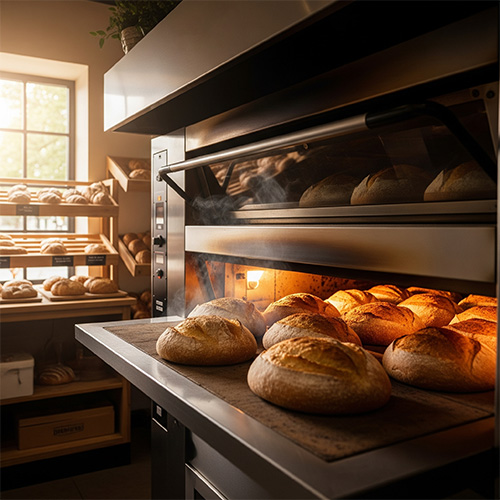
Convection Ovens use circulated hot air to bake products evenly, ideal for small to medium-scale bakeries.
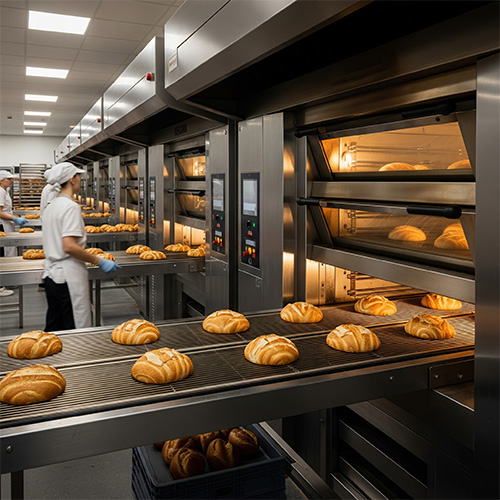
Tunnel Ovens provide continuous baking for large-scale production, allowing high throughput with consistent results.
Combi Ovens combine steam and convection, giving bakers flexibility to produce a wide range of products from crusty bread to delicate pastries. Proper oven selection ensures optimal baking consistency and reduces energy waste.
Fermentation is a critical stage for flavor and texture development.
Proofing Cabinets maintain controlled temperature and humidity to allow dough to rise uniformly.
Retarders slow down fermentation, allowing bakeries to plan production schedules without compromising dough quality. Consistent proofing directly affects the final product’s structure, taste, and shelf life.
Efficient cooling and packaging are as important as baking.
Cooling Conveyors ensure baked goods cool evenly before packaging, preventing condensation and spoilage.
Packaging Machines automate wrapping, sealing, and labeling, reducing labor costs and maintaining hygiene. Well-integrated cooling and packaging lines help streamline production and maintain product integrity.
Regular maintenance is essential to prolong equipment lifespan and maintain safety standards.
Routine maintenance prevents breakdowns, reduces downtime, and ensures a consistent production workflow.
| Equipment Type | Best For | Capacity | Speed Options |
|---|---|---|---|
| Planetary Mixer | Dough, batters, sauces | 5–20 liters | 6–10 speeds |
| Spiral Mixer | Bread & pizza dough | 10–30 kg dough | 2–3 speeds |
| Floor Mixer | High-volume mixing | 20–60 liters | 3–12 speeds |
| Dough Sheeter | Laminated dough | 1–5 kg per sheet | Variable |
| Dough Divider | Consistent portioning | 10–50 kg dough | Adjustable |
This table provides a quick overview to compare essential bakery equipment for efficiency and capacity planning.
Choosing the right combination of equipment will directly improve production efficiency and reduce operational costs.
Selecting the right industrial bakery equipment is crucial for maintaining product quality, maximizing efficiency, and ensuring staff safety. From mixers to ovens, proofing cabinets, and packaging lines, each piece plays a vital role in streamlining production. Evaluating your bakery’s capacity, product range, and workflow will help you invest in equipment that supports long-term growth.
Can industrial bakery equipment handle large-scale production?
Yes. Industrial bakery machines are specifically engineered for continuous, high-volume operation. They maintain consistent product quality, handle heavy dough or batter loads, and reduce manual labor. Using properly sized equipment ensures efficiency even during peak production periods.
Is specialized training required to operate these machines?
Basic training is essential to operate industrial bakery equipment safely and efficiently. Most manufacturers provide detailed manuals, safety guidelines, and operator courses. Proper training minimizes accidents, prevents damage to machinery, and ensures consistent baking results.
How often should equipment be serviced?
Daily cleaning after each shift is required, along with weekly or monthly maintenance checks depending on usage intensity. Regular lubrication, inspection of motors and attachments, and timely replacement of worn parts help prevent breakdowns and maintain consistent production.
Are these machines versatile for different types of baked goods?
Yes. Modern industrial mixers, ovens, and sheeters are designed to handle a variety of dough types, batters, and pastry products. With adjustable speed settings, temperature controls, and attachments, these machines can produce bread, pizza, pastries, and more efficiently.
How to optimize energy efficiency in an industrial bakery?
Energy efficiency can be optimized by using programmable ovens, energy-efficient motors, and scheduling production to minimize idle machine time. Properly maintained equipment also consumes less power, reducing operational costs while maintaining consistent product quality.
If you’re unsure which machines are best for your production needs, our experts are here to help. Contact us today for a personalized consultation, and ensure your bakery runs efficiently, safely, and reliably. Don’t wait—get in touch now to optimize your operations!