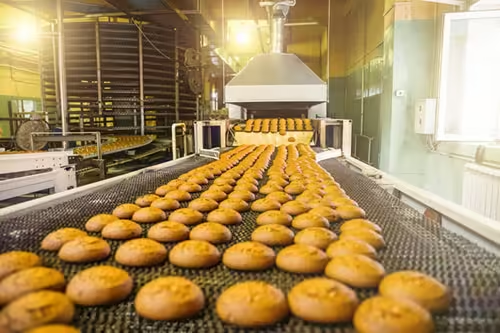

Running a successful bakery requires more than just passion for bread—it demands efficient, reliable, and scalable production systems. One of the most significant investments you can make is a commercial bread production line, which streamlines every stage from mixing to packaging. In this guide, you’ll discover how to select the right system, optimize your workflow, and make data-driven decisions to increase output and product consistency.

A commercial bread production line is a fully integrated system designed to automate the stages of bread production. This typically includes:
By using a production line, bakeries can standardize quality, reduce labor costs, and scale operations efficiently. According to a 2023 report by the International Baking Association, bakeries using automated production lines reduced labor requirements by 40% while increasing output by 50%.
To choose the right system, you must understand its main components:
High-capacity dough mixers ensure uniform consistency and elasticity. They handle large batches, which is essential for maintaining quality across multiple loaves. Strong stirrers and programmable settings allow you to control dough hydration and mixing speed.
Automated proofing cabinets regulate temperature and humidity, allowing dough to ferment consistently. Some modern systems offer multi-stage proofing to optimize flavor and texture.
Shaping machines divide, round, and mold dough into consistent loaves. Advanced models allow for customization of loaf size and shape to meet market demands.
Industrial ovens with conveyor systems or deck setups provide even heat distribution, ensuring a consistent bake. Steam injection and zoned temperature control further enhance crumb structure and crust quality.
After baking, automatic cooling conveyors prevent moisture buildup. Integrated packaging machines can portion and wrap bread efficiently for retail or wholesale distribution.
Selecting the right line depends on your bakery’s scale, product types, and production goals. Here’s a comparison table of common production line configurations:
| Feature | Small-scale Line | Medium-scale Line | Large-scale Line |
|---|---|---|---|
| Daily Output | 500–1,500 loaves | 1,500–5,000 loaves | 5,000–20,000+ loaves |
| Dough Mixing Capacity | 50–100 kg | 100–300 kg | 300–800 kg |
| Shaping Options | Basic loaf | Multiple loaf types | Customizable shapes & sizes |
| Oven Type | Single deck | Multi-deck | Continuous conveyor |
| Automation Level | Semi-automatic | Mostly automatic | Fully automatic |
This table helps you evaluate which system aligns with your production needs.
Consider a mid-size bakery producing 2,000 loaves per day. Before automation, their labor-intensive workflow led to inconsistencies in bread texture and wasted raw materials. After integrating a medium-scale commercial bread production line, they achieved:
This case demonstrates the practical benefits of upgrading to a well-designed production line.
When evaluating a commercial bread production line, focus on:
Even advanced production lines can face challenges. Some frequent issues include:
Proactive monitoring and staff training can minimize these risks and ensure smooth operations.
Here are actionable steps to make the most of your commercial bread production line:
The baking industry is rapidly evolving, and modern commercial bread production lines are embracing:
How do I determine the right production line size for my bakery?
Consider your daily output, product variety, and growth projections. Small bakeries may only need 500–1,500 loaves/day capacity, while industrial-scale bakeries may require 5,000+ loaves/day.
Can I customize my line for specialty bread?
Yes, most modern lines allow adjustments in shaping, proofing, and baking to accommodate different loaf types and sizes.
How much space is required for a commercial bread production line?
Space requirements vary by capacity. Medium-scale lines typically need 200–400 square meters, including room for storage and packaging.
What maintenance is needed for a commercial bread production line?
Routine cleaning, lubrication of moving parts, calibration of sensors, and checking ovens for uniform heat distribution are essential.
How long does it take to install a production line?
Depending on complexity, installation can take 4–12 weeks, including training and testing for optimal operation.