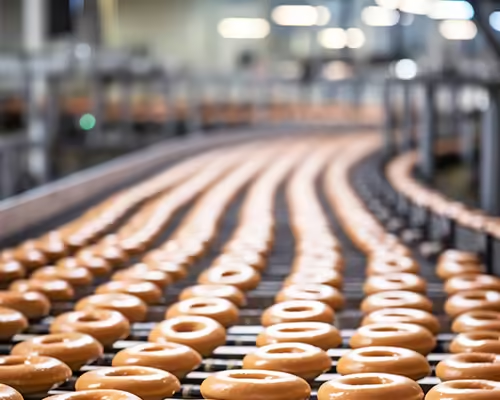

Running a bakery efficiently requires more than just skilled bakers—it demands the right equipment to produce consistent, high-quality baked goods at scale. One of the most crucial pieces of equipment is the industrial bakery oven. Choosing the right oven impacts product quality, energy consumption, production speed, and ultimately your bottom line.
Whether you operate a large commercial bakery, a chain of bakeries, or a food processing facility, understanding the differences between oven types, their features, and operational requirements is key to maximizing productivity. In this guide, we will explore how to select, optimize, and maintain an industrial bakery oven for optimal performance. We’ll also include real-world case studies, actionable insights, and data-driven comparisons to help you make informed decisions.
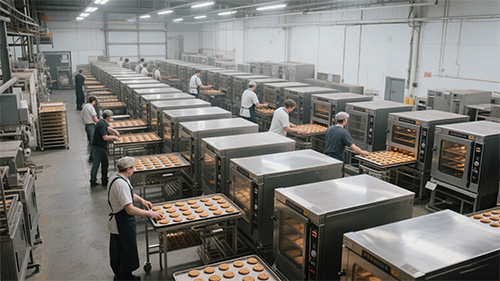
An industrial bakery oven is designed to handle high-volume baking while ensuring uniform heat distribution, consistent product quality, and operational efficiency. Unlike conventional kitchen ovens, industrial ovens are engineered for continuous operation and heavy-duty use.
Typical components of an industrial bakery oven include:
According to a 2025 bakery industry report, bakeries that invest in modern industrial ovens can reduce production inconsistencies by 20–25% while improving energy efficiency by up to 15%.
Choosing the right type of oven depends on your production volume, product range, and floor space.
| Oven Type | Throughput (loaves/hr) | Key Features | Best For |
|---|---|---|---|
| Deck Oven | 150–800 | Individual deck control, steam injection | Artisan bread, baguettes |
| Conveyor Oven | 500–2000 | Continuous baking, uniform airflow | Sandwich bread, mass production |
| Rack Oven | 300–1500 | Multi-rack loading, flexible batches | Large-scale industrial bread |
| Tunnel Oven | 1000–5000 | Continuous high-volume output | Factory-scale production |
Case Example: A medium-sized bakery producing 1,500 loaves per day switched from deck ovens to a conveyor oven system. The bakery increased throughput by 40% and reduced energy costs by 12% due to optimized airflow and heat distribution, as recorded in internal operational data.
Match the oven capacity to your daily production goals. Overloading an oven can lead to uneven baking, while underutilizing it is inefficient and increases per-unit costs.
Look for ovens with reliable air circulation systems. Uneven heat can cause inconsistent baking, with some loaves undercooked while others are overbaked. Studies show that ovens with advanced convection systems improve uniformity by 18–20%.
Energy consumption is one of the largest operational costs in a bakery. Choosing an oven with insulation, efficient heating elements, and programmable controls can reduce energy usage by up to 15%.
Modern industrial ovens can handle multiple products, from bread to pastries, with programmable settings for different temperatures, baking times, and steam injections.
Proper steam management is essential for achieving optimal crust and crumb texture in bread.
Benefits of steam injection:
Operational Tip: Use digital controls to regulate steam precisely at different stages. A bakery that implemented automated steam injection reduced product defects by 22% over six months.
Automation can greatly enhance productivity and reduce labor costs. Key features to consider:
Case Example: A bakery chain integrated a rack oven with programmable cycles for multiple bread types. They reduced labor hours by 30% while maintaining consistent product quality across multiple locations.
The placement of your ovens within the production line is critical. Consider:
A bakery reconfiguring their production floor around conveyor ovens saw a 25% reduction in internal transport time, improving overall efficiency.
Proper maintenance ensures consistent baking quality and extends oven lifespan.
Tips:
Bakeries with structured maintenance programs report 20–30% fewer production delays.
| Feature | Deck Oven | Conveyor Oven | Rack Oven | Tunnel Oven |
|---|---|---|---|---|
| Throughput | Medium | High | Medium-High | Very High |
| Energy Efficiency | Moderate | High | Moderate | High |
| Product Flexibility | High | Medium | High | Medium |
| Initial Cost | Moderate | High | High | Very High |
| Maintenance | Moderate | Moderate | Moderate | High |
When selecting an oven, weigh production volume, product type, energy efficiency, and automation needs to find the right balance.
Choosing the right industrial bakery oven is a critical decision that directly impacts your bakery’s efficiency, product quality, and profitability. By understanding different oven types, evaluating capacity and automation needs, and implementing best operational practices, you can build a scalable, high-performing bakery that meets both current and future demands.
What is the main difference between industrial and commercial bakery ovens?
Industrial ovens are built for high-volume, continuous operation with advanced automation, whereas commercial ovens are designed for smaller-scale bakeries.
How long does it take to recover the investment on an industrial bakery oven?
ROI typically ranges from 2 to 4 years, depending on production scale, energy efficiency, and labor savings.
Can one oven type handle multiple bread varieties?
Yes, ovens with programmable cycles and adjustable temperature/steam controls can bake different products with consistent quality.
What is the average lifespan of an industrial bakery oven?
With proper maintenance, industrial ovens can last 10–15 years, depending on usage and care.
How can I reduce energy costs with my oven?
Select ovens with good insulation, variable-speed fans, and programmable heating cycles. Additionally, group production batches to optimize oven utilization.